Welcome to my Blog
This is a place where the visitors are confronted with their search for a personal touch and where they have an opportunity to get acquainted with a skilled expert, who has turned durability and tradition into a personal passion.
I hope this will become a valued and rich source of inspiration and knowledge. Please Leave comments and enjoy your visit. Please note text and pictures on this blog are Copyright protected.

Showing posts with label Germany. Show all posts

Friday, 23 February 2024

Heraldic coat of arms for student fraternity carved in wood | Burschenschaft Germania zu Würzburg, Germany


Burschenschaft Germania zu Würzburg |   Heraldic coat of arms-shield for student fraternity carved  in wood
Coat of arms for student fraternity carved in wood
Burschenschaft Germania


Burschenschaft Germania zu Würzburg |
 Heraldic coat of arms-shield 
for student fraternity carved  in wood

A unique project was delivered in the spring of 2018.

A rather large heraldic sculpture in lime wood and this for a German student association from Würzburg, a 'Burschenschaft'.

This unique sculpture for Germania Burschenschaft Zu Würzburg was intended as a commemoration of their 200th anniversary.

The commission

In the autumn of 2016 I received the visit of Mr. Bussmann, the spokesman of Burschenschaft Germania zu Würzburg, I had already had several times contact with this pleasant man by phone and via email.

After some negotiations about his specific wishes, the cost price, the dimensions of the sculpture, technical details, the colour determination and not unimportant, the delivery date, this resulted in an agreement.

Design heraldic coat of arms


Heraldic coat of arms for student  fraternity carved in wood | Burschenschaft Germania zu Würzburg, Germany

As we have discussed a number of times in this blog, a beautifully executed carving always starts with a beautiful and well thought-out design. Designs sent by the client(s) cannot always serve as a blueprint for the execution in wood. The heraldist who makes paper designs does not need to take into account the logic so that it can be executed in wood.

Also in this case, a new design was definitely recommended. In consultation with Mr. Bussmann was opted for a heraldic coat of arms in wood that looks at you, a heraldic term for a heraldic coat of arms whose helmet looks at you frontally.

The heraldic colours as on the already submitted designs had to remain correct and preferably the same. After a number of preliminary designs, a beautiful baroque design emerged.


But what is a Burschenschaft?


For the blog reader who does not know exactly what Burschenschaften are, here is a brief explanation. These traditional German student associations have their origins in the *Urburschenschaft of Jena from 1815.

 *The Urburschenschaft followed the idea of abolishing the regional associations at the universities and bringing all students together in a "general brotherhood".

The name Burschenschaft comes from Bursche, which means boy or student in the German language. The Burschenschaften were based on liberal and patriotic ideas. "Burschenschaft" is, however, only used by a small proportion of very different German student associations today.

Only 300 of the 1500-2200 student associations in the German language area can be called a "Burschenschaft". In public, the term is often wrongly used as a collective term for all student associations. 

Most student associations that are not Burschenschafts have historically no connection with the Burschenschaften and have a completely different organisation.

In particular, some members of the largest umbrella organisation of Burschenschaften (Dachverband), the Deutsche Burschenschaft, have a political functioning for historical reasons. 

Traditionally oriented student associations are therefore nowadays - and not always unjustly - considered by public opinion in the German-speaking world as politically right-wing to extreme right-wing, often to their dismay. For example, the Corps (the oldest form of student union) explicitly does not want to be considered part of the Burschenschaften.

Burschenschaft Germania zu Würzburg, Germany
 Burschenschaft Germania zu Würzburg, Germany,  Fraternity House

Remarkable !
The mensuration (Wikipedia) 

A striking feature of the Burschenschaft is the academic duelling or academic fencing, also called the mensuration (mensur in German).

Modern academic fencing cannot be fully described as a duel nor as a sport. It is a way of training character and forming personality in the Corps student. There is no official winner at a Partie (fight), although one can usually recognise the better participant (called Paukant). Battles were also often held in the past with the aim of restoring honour or safeguarding it (e.g. in the case of an insult).


Mensuration clearly differs from the better known sports fencing. The opponents stand at a fixed distance from each other, which also explains the word mensuration ("measurement"). In sports fencing, movement is allowed while the mensuration is more static. The performers of the academic fencing art fight with stretched arms and try to hit the unprotected parts of the opponent's head and face.


Mensur

During the fight, it is not permitted to dodge blows or protect one's own face with arms or hands in order to avoid injuries. Because of the fixed distance between the participants, it is only possible to hit certain spots on the head of the opponent. When dodging (the so-called Mucken) or self-protection by means of the arms, the distance is reduced, which can cause more serious wounds. 

The strictly measured distance (a sword length or a blade length depending on the local rules or Fechtkomment) is thus a kind of protection and is the origin of the word mensuration (measurement). The opponents are, as it were, perfectly 'measured' for each other in terms of distance, as well as height, weight, age and mensuration experience.

At each competition (Partie), there are usually one or two doctors present (sometimes also a medical student). Each competitor used to have his own doctor to administer care after the fight, but nowadays one supervising (certified) doctor (Paukarzt) is used. The doctors can also end the duel depending on the nature of any injuries. Wounds are often stitched on the spot, usually without anaesthetic.

Heraldic coat of arms for student association in wood

Burschenschaft Germania Zu Würzburg celebrated its 200th anniversary in 2018 by having their personal heraldic coat of arms carved in wood as a memento. It is the first time I had the honour of carving a heraldic coat of arms for a student association. This oversized coat of arms was made of lime wood and is about 1.20 metres high with the correct heraldic colours. 

When the coat of arms was inaugurated in the spring of 2018, and I was confronted with the spatial dimensions of the student house (Verbindungshaus), it seems that the whole could have been a bit bigger. The Verbindungshaus of Germania Würzburg is a beautiful 18th-century villa just outside Würzburg, and lies on slopes of Main between vineyards and historical sites such as the Wallfahrtskirche Käppele and Festung Marienberg. 

The view of Würzburg from the terrace of the student house is stunning.

Heraldic coat of arms for student  fraternity carved in wood | Burschenschaft Germania zu Würzburg, Germany

Some pictures of the room where my heraldic sculpture is exhibited. I wish them and future generations much pleasure with their purchase.

Here are some pictures of the creation of this sculpture.


The Project

Heraldic coat of arms for student  fraternity carved in wood | Burschenschaft Germania zu Würzburg, Germany


The feathers


Helmet


Chain


Merging the elements

Heraldic coat of arms for student  fraternity carved in wood | Burschenschaft Germania zu Würzburg, Germany

Mantling


Banner with logo


Heraldic coat of arms for student  fraternity carved in wood | Burschenschaft Germania zu Würzburg, Germany

Shield


Carving a fraternity shield in wood

Heraldic colors


Heraldic coat of arms for student  fraternity carved in wood | Burschenschaft Germania zu Würzburg, Germany

Fraternity Germania zu Würzburg | Fraternities Heraldic arms for student fraternity in
Fraternity Germania zu Würzburg

Heraldic coat of arms for student  fraternity carved in wood | Burschenschaft Germania zu Würzburg, Germany

Fraternity Germania zu Würzburg


Heraldic coat of arms for student  fraternity carved in wood | Burschenschaft Germania zu Würzburg, Germany

More regarding coat of arms carved in wood.
Please visit our websites

Saturday, 1 July 2017

The palace of Augustusburg and hunting lodge “Jagdschloss” Falkenlust | Educational excursion with some students ornamental woodcarving to the castles of Brühl

Educational excursion with ornamental woodcarving course members to the castles of Brühl 
The palace of Augustusburg & hunting lodge “Jagdschloss” Falkenlust

The palace of Augustusburg and hunting lodge “Jagdschloss” Falkenlust

For many years now I have been undertaking annual, educational excursions with some of my ornamental woodcarving course members. In this context, the famous palace of Versailles has always been a popular destination. This year I thought it was time for something different. A couple of magnificent places in Germany came to mind. We thought it would be a great idea to visit the castles of Brühl, i.e. the palace of Augustusburg and hunting lodge (German: jagdschloss) Falkenlust. These are two prime examples of German rococo, located not too far from the Belgian border, which have been rightfully included on the UNESCO World Heritage list.

Unfortunately we were not so lucky with the weather, as it rained throughout the whole day.
With a couple of cars we drove in the direction of Brühl, situated close to Cologne. It was only a 1 hour 15 minute drive from Maaseik ( where I live), making it acceptable for people who do not enjoy long car or bus rides. I have probably already visited these UNESCO World Heritage sites at least 10 times, but being in the company of several of my “students” gave an entirely different feel to this excursion, compared to when visiting Brühl by myself.

I tried to answer all the questions my students have, but I also learned new things about this fascinating style period (rococo). As always, I was very much attracted to the splendid rococo compositions, executed in stone, plaster and wood.

Hunting Lodge Falkenlust in Brühl

 
Hunting Lodge “Jagdschloss” Falkenlust
First up was hunting lodge Falkenlust. Originally this palace was used by the archbishop-elector and of Cologne Clemens August of Bavaria strictly for falconry and hunting. Afterwards his girlfriend and children also moved in. This hunting lodge opened its doors at 10:00 AM. As always the staff was very friendly and courteous. They were very happy to see a bigger group visiting the castle.
As we were also planning to visit the palace of Augustusburg later that day, we opted for the combi-ticket which costed 12 euros (June 25th 2016). The discount price was 10 euros.

It was highly recommended to use the audio guide, which was included in the ticket. Depending on your personal interests and the use of the audio guide a tour of this intimate hunting lodge took roughly 1 to 1.5 hours.
It was not allowed to take photographs of the interiors. The same was true for the palace of Augustusburg, and the staff made sure that the rules were strictly abided by. After some searches on the internet I did however manage to find a couple of nice photos of the Falkenlust rococo interiors.

Hunting Lodge Falkenlust in Brühl

After the visit we returned to our cars, and a 5 minute drive took us to the palace of Augustusburg. The parking lot (free of charge) was located close to the Brühl train station. This was quite useful, especially when you contemplate visiting downtown Cologne; something we did later that day. A return ticket Brühl-Cologne costed 4.5 euros, and a train ride of approximately 15 minutes took us the famous Cologne cathedral. What a luxury, especially considering the high parking costs, the low emission zone tax, and the time spent to reach the old town.

To the visitor, who is lucky enough to pick a day without rain I would highly recommend to visit the palace of Augustusburg first, then to leave your vehicle on the above-mentioned parking lot and to proceed on foot through the lovely park and forest to the hunting lodge Falkenlust.
I have done this a couple times myself and the 25-30 minute walk is truly a pleasant change of pace.

An impression of the walk to Falkenlust in 2008.


The palace of Augustusburg

The palace of Augustusburg in Brühl, close to Cologne, is generally considered the architectural pinnacle of European architecture of the first half of the 18th century. This residence of the archbishop-elector of Cologne Clemens August of Bavaria, of the House of Wittelsbach, is one of the first rococo style buildings in Germany.
Construction started in 1725 and was overseen by Johann Conrad Schlaun. From 1728 onwards work continued on the interiors and decoration based on the designs of architect François de Cuvilliés. He also designed the decorations found on the facades and in the grand reception room in Regency and late Baroque styles.


Interesting to note is that François de Cuvilliés was born in Belgium and later settled in Munich, Germany, to become an accomplished interior designer, sculptor and stucco master.
The center piece or showpiece of Augustusburg is undoubtedly the west wing staircase, which is both elegant as well as dynamic; truly an architectural masterpiece and a real treat for the eyes. It was designed by Johann Balthasar Neumann who was also responsible for the staircase in the palace of Würzburg.

Augustusburg in Brühl | German Palace

The palace of Augustusburg

Johann Heinrich Roth completed the palace interiors, including the “Gardensaal”, located on the first floor and lavishly decorated with stucco.
In concordance with the client’s expensive taste, and the prevailing style of the time, a lot of stucco marble was used. Stucco marble or “scagliola” was used extensively on pilasters and walls, often combined with trophies and other ornaments, instead of real marble. 

In those days marble was often considered too ordinary to be used as decoration. The baroque style garden (French) from 1728 can still be enjoyed in its original splendor.
This palace with its staircase and garden is one of the most important creations of German baroque.
The prince-electors only used the palace of Augustusburg as hunting and summer palace, and was inhabited approximately 4 to 6 weeks of the year. Their main residences were the Electoral Palace and Palace Poppelsdorf in Bonn.  

When Clemens August died in 1761, construction on the main halls was still ongoing. His successor Max Friedrich von Königsberg (1761-1784) oversaw the completion of the palace as planned by Clemens August. After more than 40 years of construction the palace of Augustusburg was finally completed in 1768.
With the advent of the French Revolution the prince-electorate of Cologne seized to exist in 1794. 
French troops occupied the castle and sold all the furniture. When Napoleon visited the castle in 1804, he liked it so much that he wished it had wheels. In 1809 he donated it to marshal Davoust, who neglected it completely.

Augustusburg in Brühl | German Palace
On the train to Cologne

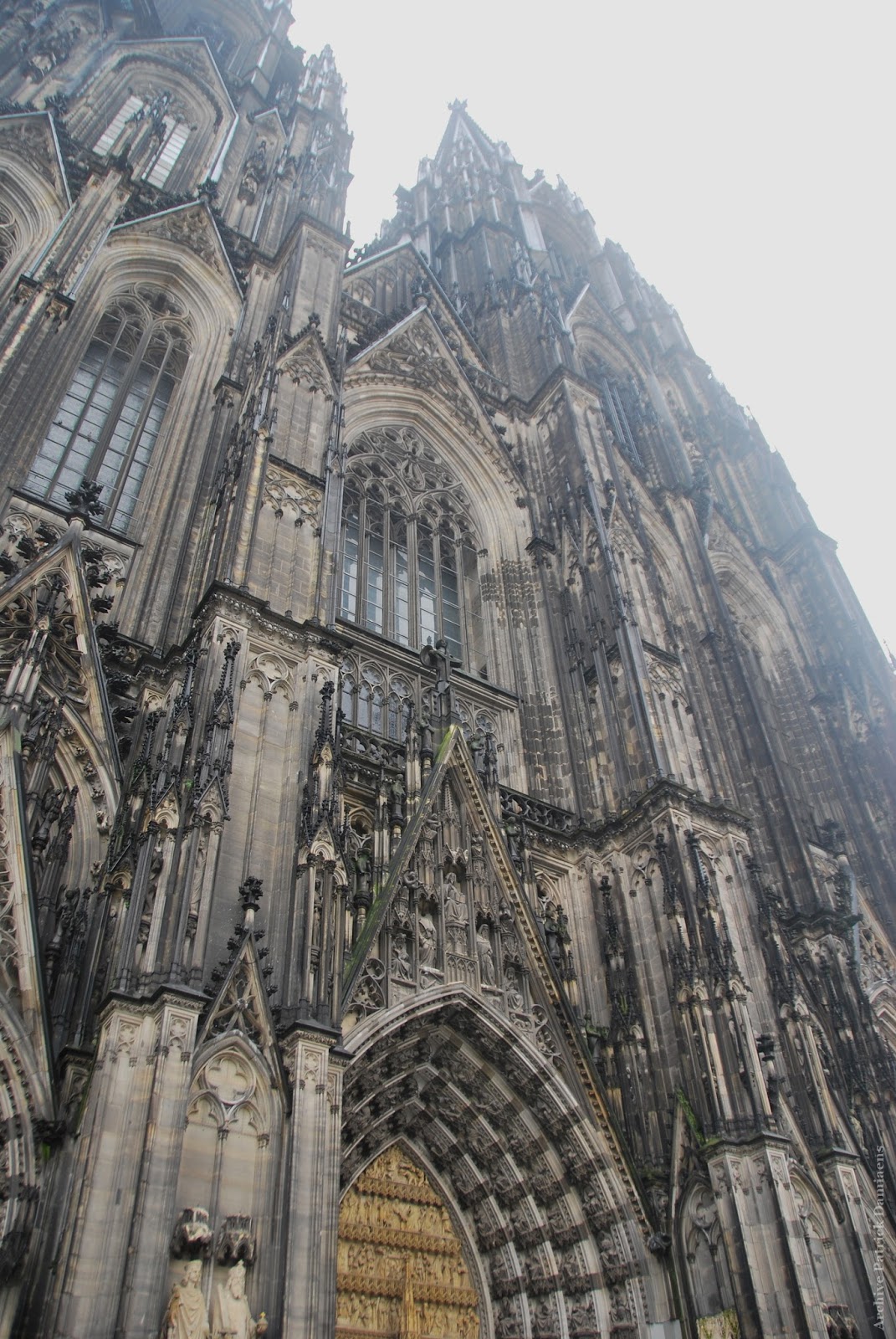
As mentioned, we also scheduled a short visit to Cologne. Due to the rain we decided to just visit Cologne Cathedral (German: DOM), rather than discovering the old center on foot. It was a challenge to ascend the 157.31 meter south tower with its 509 steps. This massive edifice is located close to the Rhine River (250 meters), and the main train station. Cologne Cathedral, officially called the High Cathedral of Saint Peter, was built in Gothic style with a cross shaped floor plan. Including the nave and towers this cathedral is 144.58 meters long and 86.25 meters wide.

Cologne Cathedral


Construction started on August 15th 1248 but was halted in the 15th century due to lack of funding. Centuries later, in 1824, construction resumed based on the original medieval design. Finally in 1880 the cathedral was completed in Neo-Gothic style. Only the base of the west tower dates back to the 13th century. It wasn’t until 1956 that all the damage caused by the war was repaired, and the church could be officially reopened.

The Cologne Cathedral boasts an impressive inventory including a couple of stained glass windows dating back to the 14th and 16th centuries.


Cologne Cathedral, 509 steps higher


After a visit to a local “Brauhaus”, for which Cologne is famous, we took the 18:00 train back to Brühl, where we ended our educational Saturday in the “Brühler Wirtshaus”. This was the old Brühl train station which had been converted to a very nice restaurant, something we experienced first-hand.

Translation Koen verhees


https://www.patrickdamiaens.info