Welcome to my Blog
This is a place where the visitors are confronted with their search for a personal touch and where they have an opportunity to get acquainted with a skilled expert, who has turned durability and tradition into a personal passion.
I hope this will become a valued and rich source of inspiration and knowledge. Please Leave comments and enjoy your visit. Please note text and pictures on this blog are Copyright protected.

Showing posts with label 'Belgian Heritage'. Show all posts

Wednesday, 7 March 2018

Church of Saint-Nicholas in Eupen, Belgium | Confessional chairs Liège style | Church interior from the 18th century


Church of Saint-Nicholas in Eupen, Belgium | Confessional chairs Liège style | Church interior from the 18th century
Church of Saint-Nicholas in Eupen, Belgium

Church of Saint-Nicholas in Eupen, Belgium | 
Confessional chairs Liège style 

 Church interior from the 18th century


As well as being rich in works of   art, the Church of Saint Nicholas at Eupen is also interesting for its special architectural features.

Eupen


Eupen is a city and municipality in the Belgian province of Liège, 15 kilometres (9 miles) from the German border (Aachen), and from the Dutch border (Maastricht) is a stone's throw from the "High Fens" nature reserve (Ardennes). The town is also the capital of the Euroregion Meuse-Rhine.
First mentioned in 1213 as belonging to the Duchy of Limburg, possession of Eupen passed to Brabant, Burgundy, the Holy Roman Empire and France before being given in 1815 to Prussia, which joined the German Empire in 1870. In 1919, after the First World War, the Treaty of Versailles transferred Eupen and the nearby municipality of Malmedy from Germany to Belgium.
German remains the official language in Eupen, and the city serves as the capital for Belgium's German-speaking Community.

Eupen, Belgium

History
According to the records, there was a chapel at Eupen in 1213, witch was replaced by a church during the 14th and 15th centuries.
The present church was built in 1720-1726 to the plans of the architect L.Mefferdatis of Aachen and consecrated in 1729. all that remains of the former church is the southern tower which has been incorporated into the new building's facade. during the 19th century it was decided to make this very simple facade more grandiose, and the work was carried out by the architect L. von Fisenne of Gelsenkirchen in 1897-1898.


Architecture
Since that time the church has had two symmetrical towers flanking an dominating the central part, all in Baroque style. The transformed tower of the earlier church is the one to the south. The entrance door in the middle of the facade is that of 1724 church, and the new facade was built in the same style.
Saint- Nicholas is of the hall-church type, that is to say with three naves op equal height and without transpet or ambulatory. 

Church of Saint-Nicholas in Eupen, Belgium | Confessional chairs Liège style | Church interior from the 18th century

This type of construction avoids the need to support the arches, making flying buttresses unnecessary.
The nave of the church is made from heavy stones partially from the earlier building. The windows are large and semi-circular with stone frames. The choir is in seven sections and is crowned with a tall pinnacle. The roof is in slate.
Inside, the arched ceilings of the three naves are decorated with some retrained stucco work. The columns of the bays are cylindrical and of polished stone.

Church of Saint-Nicholas in Eupen, Belgium


Church interior from the 18th century

Furnishings
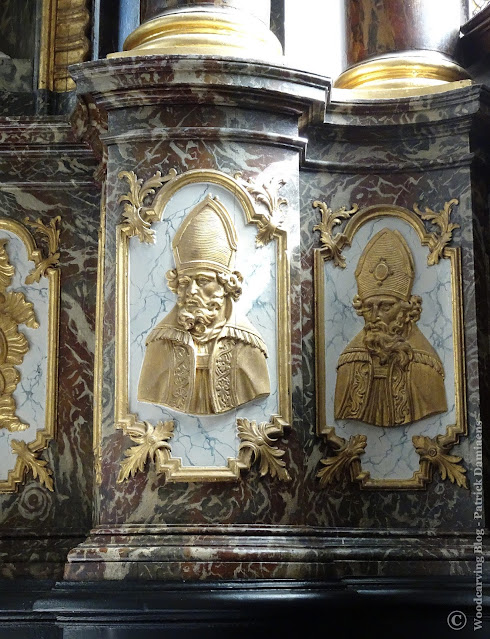
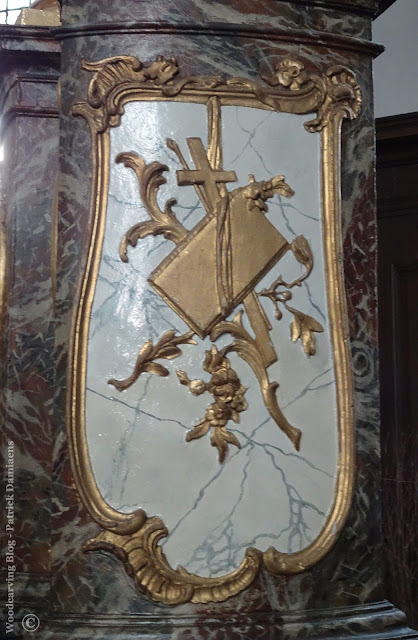
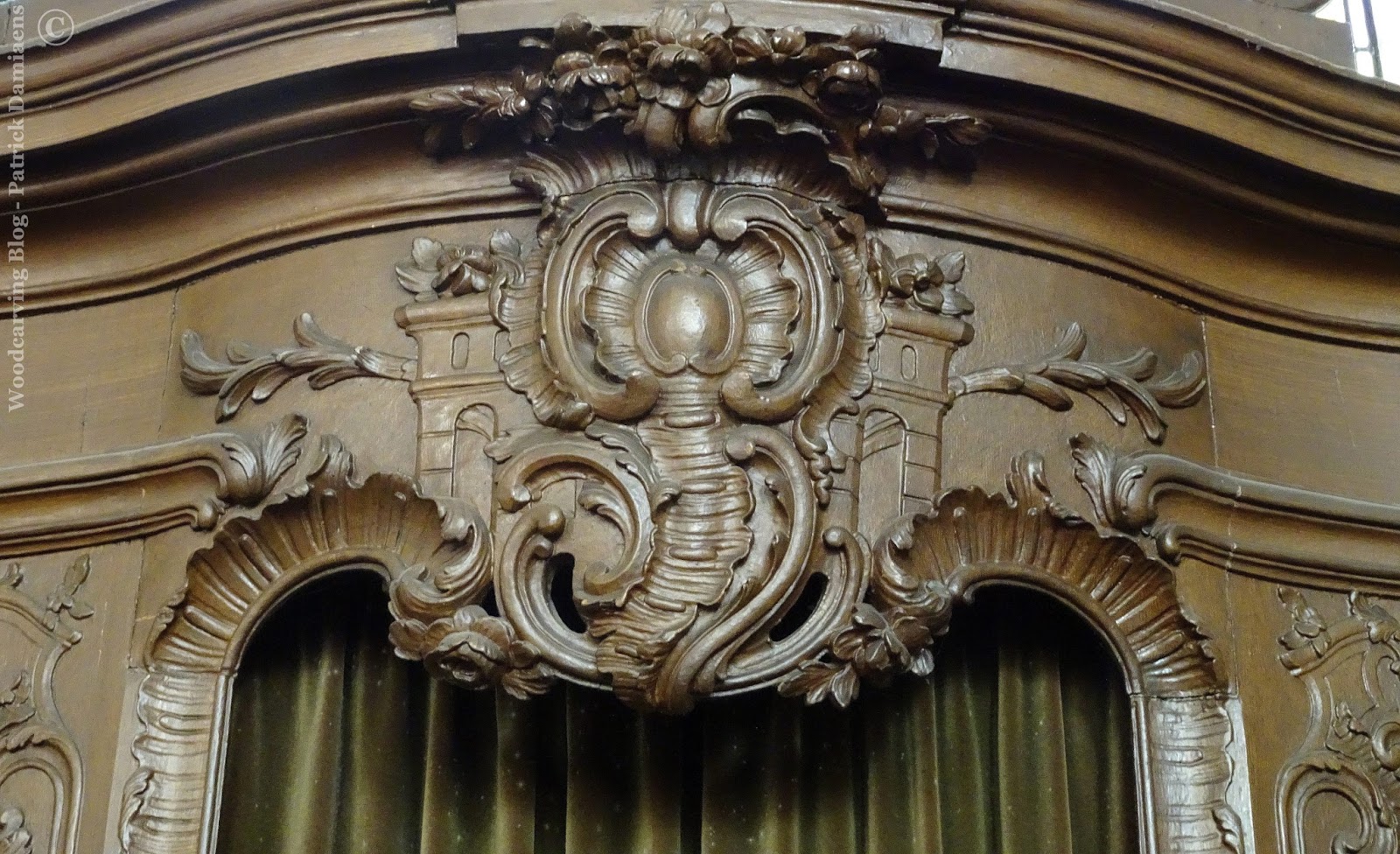
The interior decoration is in the Baroque style and the antique furnishings are especially typical of Liège. (Liège style furniture). Of particular interest are the many works of art inside the church, like the imposing and well-proportioned high altar (1740-1744), with its statues of Saint Nicholas and Saint Lambert and its sumptuous framework. The two side altars (1770) are equally remarkable. Two richly decorated niches shelter fine statues of the Virgin and Saint Joseph from the 19th century.

Confessional chairs Liège style

Confessional chairs Liège style, detail


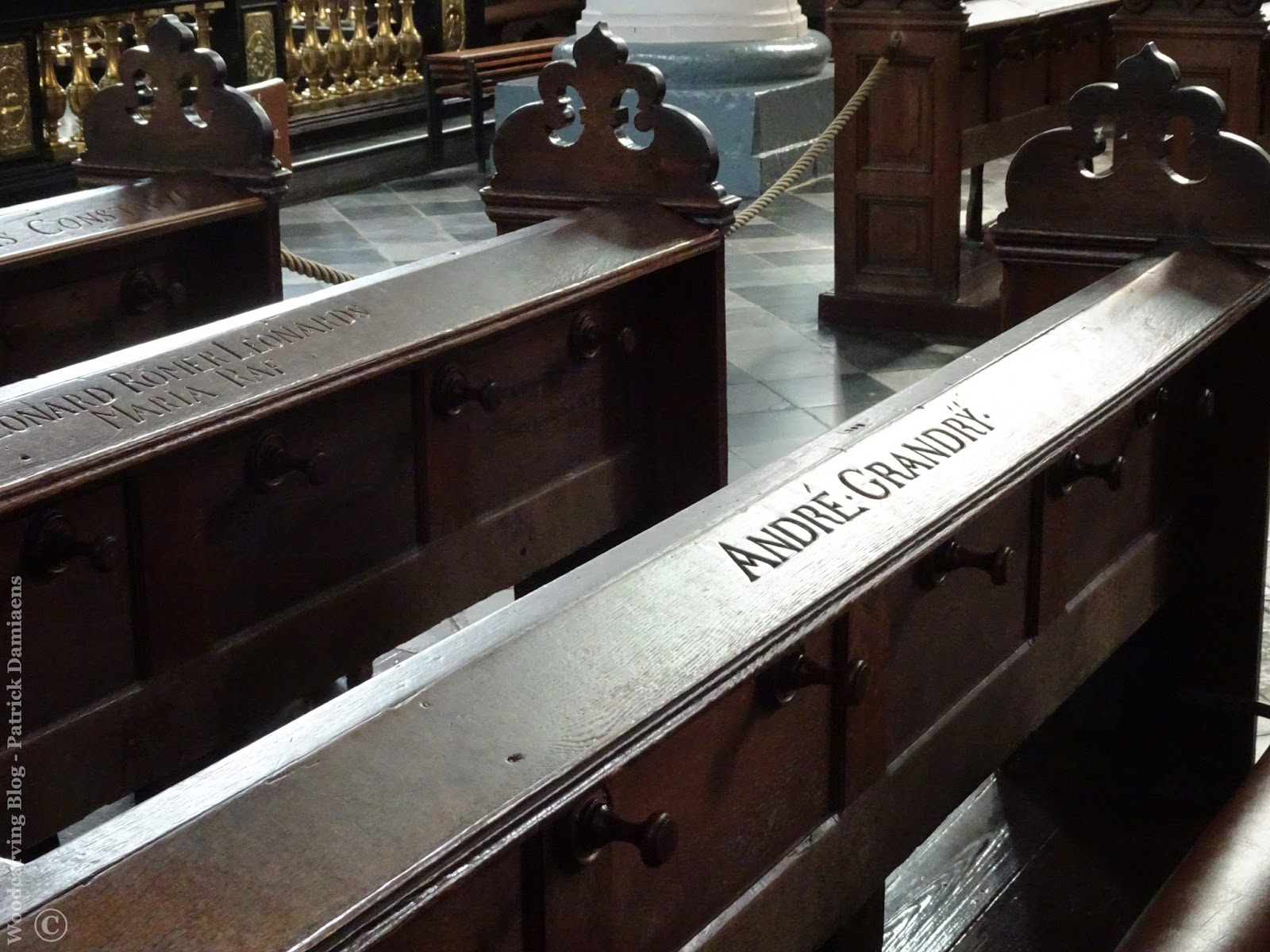
Other furnishings worth seeing include: the pulpit (1730), four confessionals (1758), beautiful, elegant
panelling, two huge candlesticks, the organs ( 1760-1762), pews in the great nave, etcc..  The statues of the apostles (1640) against the columns come from a church in Köln, Germany.

Outside, against the northern tower, ia a very fine Christ on a Cross (1852)
Also noteworthy are the elegant sculptured stone pillars standing in front of the church, linked together by the latticework railing of the ancient cemetery (1767)


Church of Saint-Nicholas in Eupen, Belgium | Confessional chairs Liège style | Church interior from the 18th century
Church interior from the 18th century

Church of Saint-Nicholas in Eupen, Belgium | Confessional chairs Liège style | Church interior from the 18th century

Church of Saint-Nicholas in Eupen, Belgium | Confessional chairs Liège style | Church interior from the 18th century

Church of Saint-Nicholas in Eupen, Belgium | Confessional chairs Liège style | Church interior from the 18th century
Church of Saint-Nicholas in Eupen, Belgium

Church of Saint-Nicholas in Eupen, Belgium | Confessional chairs Liège style | Church interior from the 18th century

Church of Saint-Nicholas in Eupen, Belgium | Confessional chairs Liège style | Church interior from the 18th century

Church of Saint-Nicholas in Eupen, Belgium | Confessional chairs Liège style | Church interior from the 18th century

Church of Saint-Nicholas in Eupen, Belgium | Confessional chairs Liège style | Church interior from the 18th century

Church of Saint-Nicholas in Eupen, Belgium | Confessional chairs Liège style | Church interior from the 18th century

Church of Saint-Nicholas in Eupen, Belgium | Confessional chairs Liège style | Church interior from the 18th century


https://www.patrickdamiaens.info

Our FB Page

Sunday, 1 June 2014

Don Bosco Liège Belgium | The disappearance of intangible cultural heritage | DISCONTINUATION of the artisan program ornamental wood carving


The dismantlement of the program ornamental wood carving at the Don Bosco Institute in Liège, Belgium.


A DISGRACE

Another piece of Belgian intangible heritage lost!


The wood carving and ornamentation program at the Don Bosco Institute is truly unique in our country, and has been around for 116 years! I was fortunate enough to attend this fine institute from 1986 till 1989. Due to the high number of enrolments, at the time, an entry exam was required; and only a total of 12 students were admitted to join the program. 

The department wood carving and ornamentation at the Don Bosco Institute was on top of its game: ”There are only a few schools of this standing found in Europe”. The groundwork of this department, founded in 1896, was of course the decoration and embellishment of furniture and interiors. For many candidates the Liège Style ornamentation was a style period with a future. It guaranteed job security for many generations of students.

But times they are a-changin’. Over the last 15 years the demand for Liège Style ornaments declined rapidly, which meant that the master craftsmen working at Don Bosco had to adapt to an ever changing situation. 

The demand for other types of wood carving increased. These included predominantly restorations of churches and other monuments, where decorative elements needed to be repaired or replaced. Furthermore, these commissions were not restricted to Liège Style ornaments. They could also include Baroque, Gothic or other style periods.


Wood carving workshop Don Bosco in 1927, Liège Belgium

Modeling of clay, Don Bosco Liège, 1951-1952


Closing down the department


Early September 2011 the management of the Don Bosco institute decided to close down the “Section Sculpture”, i.e. the section wood carving. This decision was grounded on the fact that there were only 9 enrollments for the program that year. However, other departments at the institute were experiencing similar problems, but the program wood carving and ornamentation was the only one that got cancelled. Why? This decision was never officially justified.

How is it possible that such a renowned department was no longer capable of attracting sufficient students? The topic was also discussed with the chief inspector of the educational department of wood science in Brussels. He couldn’t understand the school management’s decision either, and stated that his department had given a positive evaluation to the wood carving program in Liège, as was the case every year. 
The chief inspector deeply regretted the situation, but said his department was not too blame.
How can this loss then be explained?


Ornamental Drawing
Wood carving Workshop in 2010


Bad policy ?


The annual exhibition and open day organized by Don Bosco was one of the only moments during the year all departments benefitted from a joint effort to show off their skills; reaching a wide, more diverse audience. It was the ideal time and place to promote yourself and your “métier”, i.e. craftsmanship; also with the purpose of inspiring a new generation of students. Every year many people, both domestic and international, were eagerly looking forward to the first weekend of June, when the open day would traditionally take place. 

Indeed, this exhibition was also very popular abroad! This is not an exaggeration. I remember very well that during some editions people had to push and shove to get in. It was incredible what this school had to offer, and with what kind of passion the professors, or “professeurs des ateliers”, radiated this. They knew all too well how important that day was for their respective department.

In 2006 the new management decided that the annual open day, and other expositions inside and outside the school, no longer fitted the renewed vision of the institute. Why go through all this trouble? Why put in so much effort every year? The students would keep coming, no matter what. This perception would appear completely misplaced! Year after year the departments saw a steady decline, with fewer enrollments, which ultimately resulted in the termination of the institute’s showpiece, the “Section Sculpture”.

In 2012 yet another management team was troubled with the mistakes of their predecessors and came up with an alternative for the closed down department of wood carving and ornamentation. They proposed the idea to start a program “Kitchen installer”!?  I quote the new management: “We are continuously adapting and adjusting” (KLASSE - nr. 231; monthly magazine for education).
Of course it is appropriate and even necessary to adapt and adjust to an ever changing market, but is the installation business really waiting for this type of “school program”, when IKEA manages to summarize the intricate process of a kitchen installation on one sheet of paper? Well, what do we make of all this?


Ornamental Wood carving course in Liège Belgium


Conclusion


I have been a full time independent wood carver for over 22 years. Therefore, I know all too well how important it is to create a strong, distinct profile of my company globally, which allows people to get acquainted with my passion and craftsmanship. Our modern society expects that all information can be found online. 
The Don Bosco institute should have used the internet, social media networks and so on, to attract new students and to forge a strong global reputation. This is the fame it deserves. The line of trade where freshly graduated wood carvers end up in is without any doubt a global one. 
I am convinced that if Don Bosco would have made optimal use of the press, multimedia, exhibition possibilities and the good name of the department, it would have easily got the 12 mandatory enrollments it needed to survive. It is as the saying goes: “Unknown is unloved, unknown is unprotected”.


__________________________________ 
__________________________


Please enjoy some photos of the department wood carving and ornamentation at the Don Bosco institute in better times (2010)


 ____________________________________
___________________________

June 2013


Some time ago I was contacted by a person who was in charge of the dismantlement of the department. He asked me if I was interested in the work benches of this prestigious institute. With some of my students I went to Liège and upon arrival we noticed that the “Section Sculpture” was already stripped completely of its 116 year history. For example, all the old plaster and wooden models, dating back from the year of the department’s inception in 1896, were gone.

A unique archive of old photos, slides, books and drawings, which had been meticulously put together over the years by students and professors, disappeared. It is sometimes devastating to see how our heritage is under attack. This is what happens when ignorance gets the upper hand.

One would like to think we learned from our past mistakes, but history repeats itself. With a great deal of sadness future generations will think back to past times and realize how much unique knowledge was lost and wander who was responsible for making such rash, thoughtless decisions.


 Translation, Koen Verhees
 
https://www.patrickdamiaens.info

https://www.facebook.com/patrick.damiaens.ornamental.woodcarver