Welcome to my Blog
This is a place where the visitors are confronted with their search for a personal touch and where they have an opportunity to get acquainted with a skilled expert, who has turned durability and tradition into a personal passion.
I hope this will become a valued and rich source of inspiration and knowledge. Please Leave comments and enjoy your visit. Please note text and pictures on this blog are Copyright protected.

Showing posts with label 'Designmuseum Ghent'. Show all posts

Sunday, 1 November 2015

Hotel de Coninck in Ghent | Museum of Design Ghent | Furniture from Liege | 17th and 18th century style interiors and rooms.

Hotel de Coninck in Ghent | Museum of Design Ghent


Hotel de Coninck in Ghent,
  Museum of Design
17th and 18th century style interiors and rooms.
_____________________
_________________

A while ago I visited the city of Ghent (Belgium), a beautiful city full of amazing buildings. Ghent is “The best of both worlds”, a combination of the best from Antwerp and the best from Bruges,(two other Belgian cities) that is what CNN says on its website, and it is completely true.

In this blog article we will visit the Hotel de Coninck or “the Design Museum”.  As always, our focus is on the17th and 18th century decorative pieces of art, rooms and historic interiors.

 The Museum of Decorative Arts 

Hotel de Coninck, the Design Museum in Ghent


The Museum of Decorative Art-Hotel de Coninck, the Design Museum in Ghent, has its origins in the “Association of Industrial and Decorative Arts” founded in 1903 in Ghent. It was first housed in the Academy of Fine Arts, in the Academy Street. In 1922-1923 the collection was transferred to the Hotel de Coninck when the city bought the building. But just until 1958 the city also assumed the administration of the collection.

In 1754 the Hotel de Coninck was included in the list of buildings to protect. The conservation works started a little bit after, the side wall bears the anchors in the year 1755. The building itself is a very impressive example of the typical Flemish Bourgeois architecture from the 18th century. The request was filed in 1754 by a certain De Brouwer, but according to an inscription in the salon J. F. Allaert, the house was in possession of Ferdinand de Coninck since 1761.  


The person who has the opportunity to walk in the museum feels that he/she is immersing in the world of an 18th century rich family from Ghent
The rooms with authentic parquet floors and paneled walls and ceilings are decorated with rich furniture from the period. In May 1992 the new wing of the Design Museum in Ghent was officially opened. The building was designed by the architect Willy Verstraete. The unique pieces that were patiently gathered since the mid-1970 were preserved, in order to be exhibited. The Museum has a new building that is worth to see. From the courtyard to an 18th century façade that has been completely reconstructed. Behind it, a light and airy modern building. The unique find is a huge hydraulic lift in the central part of the building; this makes the floors more reachable. The potential to involve the audience in an exciting play of changing levels is almost unique. The collections of the “old” museum comprise furniture from the 17th and the 18th centuries, displayed in the stylish interior of the Hotel de Coninck.

Dining room at the Hotel de Coninck | Woodcarvings of  J. F. Allaert.


Dining room of the sculpture J. F. Allaert.

An Absolute highlight is the unique dining room where the wooden chandeliers –work of the Ghentse sculptor J. F. Allaerts- hangs on its original site. Other rooms are decorated with 18th century wall paintings or are lined with silk wall coverings. The lighting is provided by 18th century crystal chandeliers. Family characters have their portraits hanging on the walls, like the French King Louis XVIII, who also stablished the office located between the fine collection and the French furniture.


The staircase of Hotel de Coninck.

The newel (a central pole or support column) is decorated with a powerful volute, extended horizontally on a round base, where a goat is resting. The connection to the handrail is made by a bended pole with a braid motif and a garland of flowers. It is crowned by a magnificent carved ram’s head. 
The handrail is supported by a rectangular upwardly recessed, fluted baluster-shaped. The start of the staircase wall with its grooved plinth, his powerful volute and sculpted goat as a graceful counterpoise to the head pole. The stairway wall is decorated with wood paneling consisting in alternately of rectangular panels and fluted pilasters crowned with a rosette. The flutes include bar work. The most important part of the paneling contains a medallion with the image of Josef II.


 17th and 18th century style interiors and rooms | staircase


Style rooms at the Hotel de Coninck

Through the staircase we reach the first floor. Here you will find a hall of honor, which is surrounded by all kinds of style rooms: the Empire room, the Louis XVIII hall, the hall of Bishop Lobkowitz, the hall Ferdinand Scribe, a Director hall with paintings and a room with grisailles from the Boudelo Abbey. All of these rooms contain beautiful chimneys and various objects in the Lodewijk- or later styles.


Translation: Lis Alvarado


17th and 18th century style interior and rooms.


Museum of Design Ghent


17th and 18th century style interior and rooms.

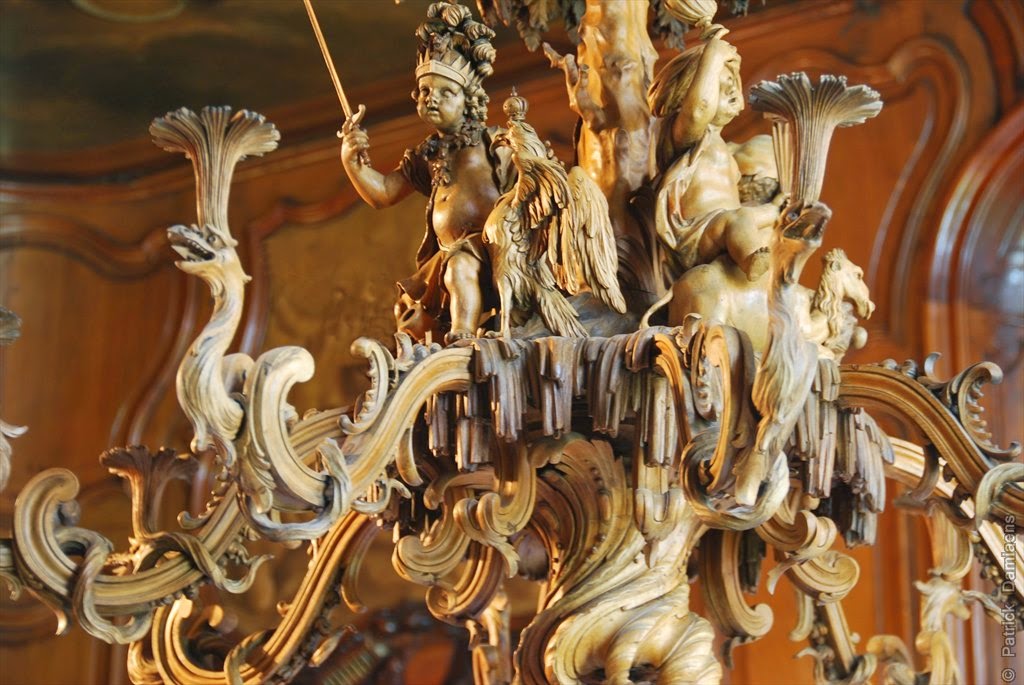
Wood chandelier from J. F. Allaert


Website: Design Museum Ghent  http://www.designmuseumgent.be

 
https://www.patrickdamiaens.info


Our FB Page

Tuesday, 1 October 2013

CARVED WOODEN CHANDELIER | WOODCARVING 18th Century Style | Flemish Woodcarver J.F. Allaert | Designmuseum in Ghent, Belgium


A little-known masterpiece 
of 18th century Flemish Decorative Arts:

The Wooden chandelier by J.F. Allaert

A little while ago, I visited Ghent. This Flemish city has a wide range of historical buildings and places of interest. And a visit to the “Hotel de Coninck” was an absolute must. This museum houses a true masterpiece of 18th century Flemish Decorative arts.

In 1961, the city council of Ghent purchased a large wooden chandelier from an antique dealer in Brussels. This purchase was made at the same time negotiations were underway with a buyer who wanted this piece for a foreign collection. This chandelier was originally made to adorn the residence of the Knight F.J. de Coninck, presently housing the museum of decorative arts (known as the “Design Museum Gent”).
A brief description of the wooden chandelier is necessary to give a better idea of this masterpiece of Flemish industrial art.
The total height of the wooden chandelier is 1.80m and the diameter is 1.17m. The chandelier was carved from limewood.

Wooden Chandelier of J.F.Allaert
The principal decoration consists of four allegorical figures, placed at the foot of the tree of life. They symbolize the continents as seen through the eyes of people in the 18th century. These four symbolic figures are each about 0.30m tall and represent the four continents Europe, America, Asia and Africa.
The four continents
Europe is depicted as a child in an upright position, wearing a helmet made of feathers. Around its neck it’s wearing a necklace of the Order of the Golden Fleece. A slightly draped skirt covers the lower part of its body. Between its legs, there’s a canon. Its right hand is gripping a sword at the hilt. Its left hand is reaching for the neck of an eagle wearing an imperial crown.
A ship connects “Europe” to “America”. This ship has been carved in great detail, with small canons coming out of the side, a mast with a crow’s nest, an anchor, etc.

America is symbolized by a child dressed up as an Indian, with drawn bow and arrow. A quiver is leaning against its right leg, which is spread out over a crocodile.
Next to “America” we find “Africa”. The figure is wearing a hat in the shape of an elephant’s head with trunk. In its right hand, the child is holding a cornucopia, from which corncobs are protruding. It’s riding a lion with long manes and a half open mouth.
Between “Africa” and “Europe” a child symbolizing “Asia” is placed on a lying camel. It’s wearing a turban for a hat, and is holding a censer in its left hand and a beam of rays in its right. This depiction evokes images of the Middle East.


The palm tree rising up between these four allegories houses a nest on top of a fan-shaped crown. An eagle is snatching a cub from the nest, right from under a winged dragon, with fiery tongue. 
This bird, with its wings spread wide, is holding an iron ring in its right claw, from which the chandelier is hanging. Underneath the allegorical figures representing the four continents, eight similarly arched arms spring from the bottom of the chandelier. These end in a dragon, of which the head supports the candle holder.

It is generally assumed that this wooden chandelier was made particularly for this residence. Tradition tells us that the artist, J.F. Allaert, worked on decorating this mansion under the patronage of the Knight de Coninck for many years. Striking is the fact that the chandelier was signed and dated on the bottom, with the depiction of the four continents sitting on top. Near the arms of the chandelier, hidden by the first rocaille, it says “J.F. Allaert 1770”.

WOODCARVING  18th Century Style


J.F. Allaert
This Flemish Woodcarver was born in Ghent on 14 October 1703 and died on 2 January 1779, at the age of 76.

Designmuseum, Ghent
Website DESIGNMUSEUM GHENT 


https://www.patrickdamiaens.info