Welcome to my Blog
This is a place where the visitors are confronted with their search for a personal touch and where they have an opportunity to get acquainted with a skilled expert, who has turned durability and tradition into a personal passion.
I hope this will become a valued and rich source of inspiration and knowledge. Please Leave comments and enjoy your visit. Please note text and pictures on this blog are Copyright protected.

Showing posts with label 'German Palace'. Show all posts

Monday, 1 February 2021

SCHLOSS BENRATH | Castle in Düsseldorf | Rococo castle interior | Rococo-style ornaments | Corps de Logis

SCHLOSS BENRATH | Castle in Düsseldorf (Germany)
Rococo castle interior

This blog entry about Castle Benrath is a translation made possible by  www.deepl.com . 
The original text you can find on my Dutch Woodcarving Blog, Ornamentsnijder Blog.

SCHLOSS BENRATH | Castle in Düsseldorf | Rococo castle interior | Rococo-style ornaments | Corps de Logis
SCHLOSS BENRATH | Castle in Düsseldorf


If you drive in the direction of Wuppertal (Bergisches Land), the city of Benrath, which used to be a small hamlet but has been a part of Düsseldorf since 1929, is located right bank of the river Rhine.

To the northwest at the end of the main street in Benrath lies the hunting and pleasure castle "Maison de Plaisance" in Rococo style with a vast park of the former Elector of the Palatinate Charles Theodore of Bavaria (1724 -1799). Karel Theodoor initially resided in Mannheim, capital of the Palatinate.
Between 1755 and 1771 he had a new summer residence built in the Rococo style in Benrath under the direction of the court architect Nicolas de Pigage.
When Charles Theodoor became Elector of Bavaria in 1777, he moved his main residence to Munich. In the summer he resided in Schwetzingen Castle, built by his uncle Charles Philip.
Charles Thedodoor and his wife Elisabeth Auguste made hardly any use of this castle. At the inauguration there was an evening party and Karel Theodoor visited the castle once on a day trip.

Elector: The elector was one of the seven, later one of the nine, most prominent princes of the Holy Roman Empire, and only they were allowed to choose a new emperor.

The domain stretches as far as the banks of the Rhine. The outbuildings of the castle are home to several museums. The castle is almost a smaller version of Schwetzingen castle.
The Schlosscafé is located in one of the gatehouses. Before we started the tour we couldn't resist to have something to eat here. A good price quality with friendly service.

SCHLOSS BENRATH | Castle in Düsseldorf | Rococo castle interior | Rococo-style ornaments | Corps de Logis

SCHLOSS BENRATH | Castle in Düsseldorf | Rococo castle interior | Rococo-style ornaments | Corps de Logis

Schloss Benrath is a particularly charming castle that survived the turbulent after years of World War II almost unharmed. In the spring of 2019 I visited the castle with a number of students. 

The castle can only be visited with a guide. Every hour a small group of people leave for a guided tour of one of the wings of the castle; a visit that takes about an hour.
The entrance fee was not too high as in many German castles, castles and palaces, and amounted to p.p. 10 Euro. ( 12,5 US Dollar) 
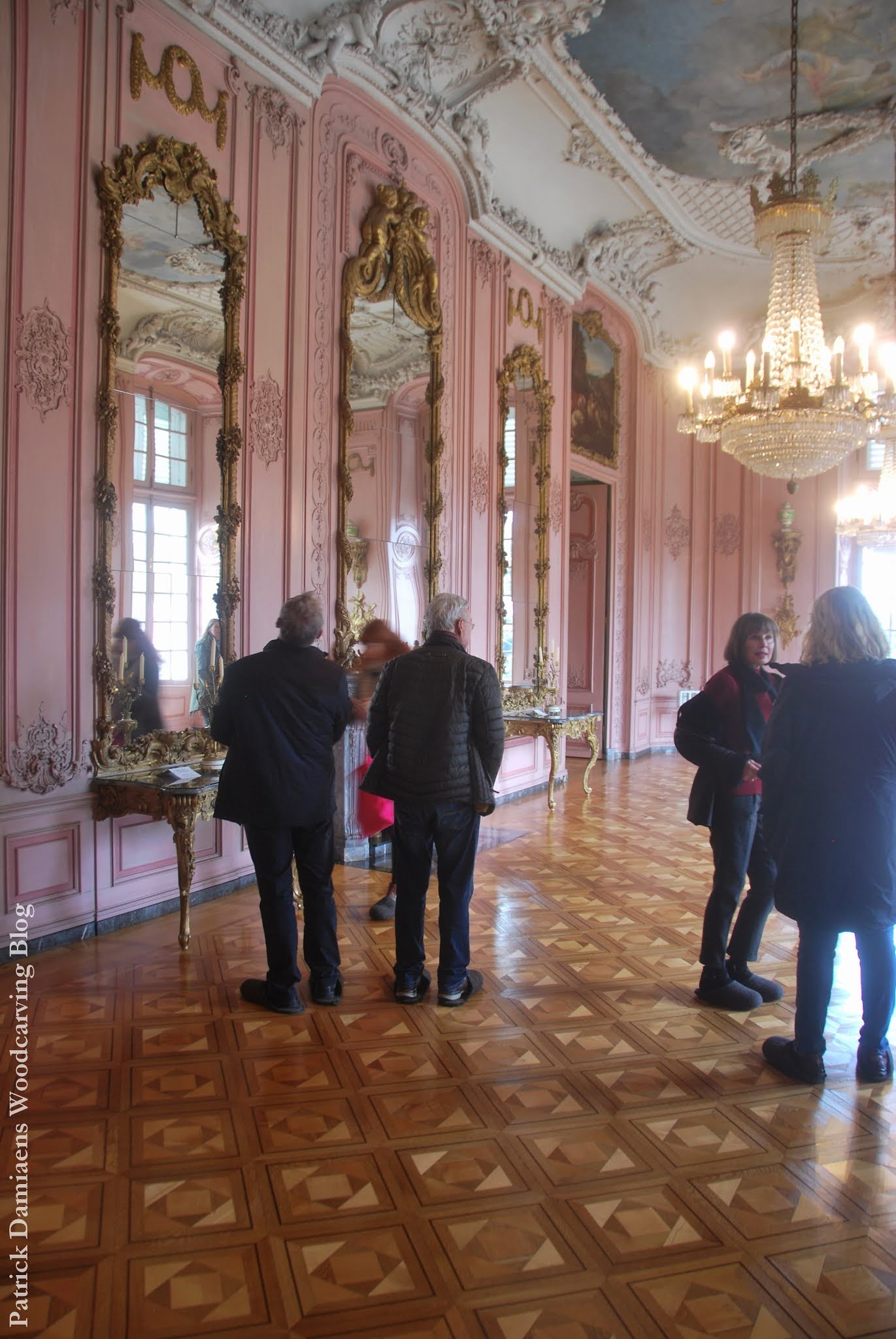
Also here are the oversized felt slippers available. These slippers are required to wear over your own footwear to protect the original floors from possible damage.  Photographing is allowed but without flash. Here we have also gratefully taken advantage of the opportunity.
Below is a short report by Schloss Benrath.

The route to the castle is clearly indicated and parking is in the park and free of charge.


Castle Benrath

The Corps de Logis is the main building of the castle which consists of five separate buildings.
The main building served as a royal residence and has four floors with a total of eighty rooms.
The two wings to the right and left of the main building (Corps de Logis) are symmetrically located on the pond and were used as service buildings. They are connected to the main building by underground corridors. In this way, the work of the service staff was hidden from view and the meals could also be brought dry to the main building. In the two side wings there are now two museums, the museum of physics and the museum of garden art. The two gatehouses on both sides guard the entrances to the domain.

SCHLOSS BENRATH | Castle in Düsseldorf | Rococo castle interior | Rococo-style ornaments | Corps de Logis


The Vestibule

The vestibule, the festive entrance, connects the inner space with the outside through the artful plasterwork. The rooms above the doors represent the four seasons and the elements earth, water, air and fire have been installed on the large wall surfaces.
The theme of nature constantly appears in the interior and exterior decoration of the castle. The idea of 'the castle as a summer residence in the countryside' is touched upon time and again. The vestibule not only served as a reception area, but also as a dining room. The original tables in this room make this clear to us.

SCHLOSS BENRATH | Castle in Düsseldorf | Rococo castle interior | Rococo-style ornaments | Corps de Logis

SCHLOSS BENRATH | Castle in Düsseldorf | Rococo castle interior | Rococo-style ornaments | Corps de Logis

SCHLOSS BENRATH | Castle in Düsseldorf | Rococo castle interior | Rococo-style ornaments | Corps de Logis

SCHLOSS BENRATH | Castle in Düsseldorf | Rococo castle interior | Rococo-style ornaments | Corps de Logis

SCHLOSS BENRATH | Castle in Düsseldorf | Rococo castle interior | Rococo-style ornaments | Corps de Logis


The dome hall

The dome room is the banquet hall of the castle. Here people celebrated and danced. At the very top, even higher than the second dome, in the turret, also called the lantern, was the orchestral space. The dome depicts a painted scene, the goddess Diana returning from her nocturnal hunt. The fact that hunting is the main theme of the castle can also be seen in the decoration on the ground floor with the numerous animals killed, hunting dogs, hunting towers, safety nets,... Three windows show us the surrounding nature. The two official entrances to the Electors' Apartments can be accessed from the domed hall. Above these (private) doors are the initials of the prince electors "CT" and "FA" who "point the way" to their personal apartments.

SCHLOSS BENRATH | Castle in Düsseldorf | Rococo castle interior | Rococo-style ornaments | Corps de Logis

SCHLOSS BENRATH | Castle in Düsseldorf | Rococo castle interior | Rococo-style ornaments | Corps de Logis

The garden room

The Electress garden room is the first private living space. We can see that the cool marble floor has just turned into a warm parquet floor. The beautifully elaborated parquet pattern, the location of the doors, the windows and the mirror were conceived with attention to symmetrical and geometric principles that played an important role in the 18th century.
Optical deception and illusions were also part of this. The two opposite mirrors create the impression of infinite spaces.

SCHLOSS BENRATH | Castle in Düsseldorf | Rococo castle interior | Rococo-style ornaments | Corps de Logis

SCHLOSS BENRATH | Castle in Düsseldorf | Rococo castle interior | Rococo-style ornaments | Corps de Logis

SCHLOSS BENRATH | Castle in Düsseldorf | Rococo castle interior | Rococo-style ornaments | Corps de Logis

SCHLOSS BENRATH | Castle in Düsseldorf | Rococo castle interior | Rococo-style ornaments | Corps de Logis

SCHLOSS BENRATH | Castle in Düsseldorf | Rococo castle interior | Rococo-style ornaments | Corps de Logis

Electress bedroom

The bedroom of the Electress is the first room in this tour which is covered with silk wallpaper, a special form of comfort. The bed stood in a niche that could be closed with hinged doors. Drawings and travel reports give us proof that the Electoress had a bed made for this in the form of a folded shell.
To the left and right of the niche there are hidden doors in the wallpaper. Behind it are small rooms that were used as a dressing room and make-up room, reading room and craft room. From there one could reach the Electoral Bathroom on one side and the toilet on the other side, a little bit dart was very modern in the 18th century.

SCHLOSS BENRATH | Castle in Düsseldorf | Rococo castle interior | Rococo-style ornaments | Corps de Logis

SCHLOSS BENRATH | Castle in Düsseldorf | Rococo castle interior | Rococo-style ornaments | Corps de Logis

SCHLOSS BENRATH | Castle in Düsseldorf | Rococo castle interior | Rococo-style ornaments | Corps de Logis

SCHLOSS BENRATH | Castle in Düsseldorf | Rococo castle interior | Rococo-style ornaments | Corps de Logis

SCHLOSS BENRATH | Castle in Düsseldorf | Rococo castle interior | Rococo-style ornaments | Corps de Logis

The Order Room (service room)

The Cabinet is the last room in the Electress living space. It was used for writing, a door hidden in the wallpaper gave access to the Order Room or service room of the Electress, the living room for the chambermaid. Here she could, among other things, adjust her clothes and spend the night. The next room was probably used as a cloakroom, if we look at the many wall cabinets. In this room there is a portrait of the French architect Nicolas de Pigage. Schloss Benrath is considered to be his architectural masterpiece.

SCHLOSS BENRATH | Castle in Düsseldorf | Rococo castle interior | Rococo-style ornaments | Corps de Logis


The upper floor

On the upper floor there are four luxuriously furnished living rooms for senior guests. Each apartment had, according to French tradition, three rooms, an antechamber, a bedroom and a cabinet. The apartments were each occupied by one person. The servants stayed in adjoining rooms. There is also a cap on this floor, which was only allowed to be entered by the Electors and their guests. From a gallery, the house staff could follow the church service strictly separated from the nobility.

SCHLOSS BENRATH | Castle in Düsseldorf | Rococo castle interior | Rococo-style ornaments | Corps de Logis

SCHLOSS BENRATH | Castle in Düsseldorf | Rococo castle interior | Rococo-style ornaments | Corps de Logis

Here are some more impressions of our visit 
at Schloss Benrath near Düsseldorf


SCHLOSS BENRATH | Castle in Düsseldorf | Rococo castle interior | Rococo-style ornaments | Corps de Logis

SCHLOSS BENRATH | Castle in Düsseldorf | Rococo castle interior | Rococo-style ornaments | Corps de Logis

SCHLOSS BENRATH | Castle in Düsseldorf | Rococo castle interior | Rococo-style ornaments | Corps de Logis

SCHLOSS BENRATH | Castle in Düsseldorf | Rococo castle interior | Rococo-style ornaments | Corps de Logis

SCHLOSS BENRATH | Castle in Düsseldorf | Rococo castle interior | Rococo-style ornaments | Corps de Logis

SCHLOSS BENRATH | Castle in Düsseldorf | Rococo castle interior | Rococo-style ornaments | Corps de Logis

SCHLOSS BENRATH | Castle in Düsseldorf | Rococo castle interior | Rococo-style ornaments | Corps de Logis

SCHLOSS BENRATH | Castle in Düsseldorf | Rococo castle interior | Rococo-style ornaments | Corps de Logis


https://www.patrickdamiaens.info


Tuesday, 15 September 2015

The Palace of Bruchsal | German Palace | A castle in Baden-Württemberg | Interior in Baroque and Rococo periods.


The Palace - Castle of Bruchsal

Bruchsal Palace  
A Castle-Palace in Baden-Württemberg 
 Interior in Baroque and Rococo periods.
_______________________
___________________ 

In this blog article we will visit the Bruchsal Castle - Palace in in Baden-Württemberg, a special big castle with an interior decoration in Baroque and Rococo periods.  

The city of Bruchsal is located in the west of Germany, in the area of in Baden-Württemberg; you will practically cross it when you're on your holiday’s trip, driving out of Belgium,the Netherlands or Luxemburg on your way to southern Germany, Austria and Italy, Bruchsal is located at the E52 near Karlsruhe.
It is really worthwhile to stop there for a moment; the city has much to offer in terms of history and the Castle of Bruchsal with its baroque interior worth a visit.
The castle houses the German music box museum. A short break during your busy highway-trip, where you can enjoy culture and have something to eat in the Castle restaurant. Highly recommended.

The Castle - Palace of Bruchsal


The Palace of Bruchsal | The entrance

Bruchsal Castle.

Bruchsal Castle was founded in 1720 as a residence for the prince-bishops of Speyer. Four of them have Bruchsal Castle built during the 18th Century, inhabited and the final was 80 years at the center of their absolute dominion and power.
Under the supervision of Cardinal Damian Hugo von Schönborn a complex of 50 buildings were built; the main building with two wings from Loss Burger sandstone is the absolute eye-catcher.

Colorful, fur and festive, that's the first impression you get when entering the 'cour d'honneur, the courtyard wedged between the three main buildings of the castle complex. The buildings are richly decorated, painted and fitted with gilded stucco. The two roof ends of the main building are very beautifully made and decorated with impressive dragons forged in metal.


Oval staircase, Balthasar Neumann

The famous Baroque architect Balthasar Neumann (1687-1753), was one of the architects who gave shape to the castle, along with many craftsmen and artists in stucco specialist who previously had worked with him in the construction of the 'Residenz "in Würzburg.
Around 1728 Balthazar Neumann designed his famous oval staircase in Baroque style for his client. A staircase unique in its kind. Two oval staircases run up on each side facing each other. 
The stairway ends impressively under a huge painted dome.

The Palace of Bruchsal |  The Prince Hall


Interior in Baroque and Rococo periods.


In the middle room with adjacent two ballrooms, the Prince Hall and the Marble Hall. 
Upon completion of the work in 1750 Schönborn's successor, Cardinal Franz Christoph von Hutten, gave the rooms a German Rococo style decoration. This work was completed in 1760.

The wall and ceiling paintings obviously have a Christian theme and all this combined with the gilded stucco and scagliola has become a very tasteful work.

 Interior in Baroque and Rococo periods.

The Palace of Bruchsal | Gilded Rococo Ornaments

The Marble Hall, Palace of Bruchsal
In the aftermath of the Second World War the castle interior was almost completely destroyed. Fortunately, the structural part of the stairwell survived the bombing of March 1, 1945. Fortunately, archives and a detailed archived photo preserved from the 19th and 20th centuries were used for the reconstruction of the castle, as original as possible. 
After visiting the palace’s corps de logis (main part of the building), we recommend you pay a visit to the German Museum of Mechanical Musical Instruments and the Bruchsal City Museum.

Translation Lis Alvardo


Bruchsal Castle Opening hours:

Tue to Sun. 10:00 to 17:00

Entrance fee: adults 5 Euro


Website:
http://www.schloss-bruchsal.de


https://www.patrickdamiaens.info

link FB PAGE