Welcome to my Blog
This is a place where the visitors are confronted with their search for a personal touch and where they have an opportunity to get acquainted with a skilled expert, who has turned durability and tradition into a personal passion.
I hope this will become a valued and rich source of inspiration and knowledge. Please Leave comments and enjoy your visit. Please note text and pictures on this blog are Copyright protected.

Showing posts with label 'grinling gibbons'. Show all posts

Thursday, 25 August 2016

Adaptation of an original work by David Esterly | Grinling Gibbons | Foliage carving in limewood | David Esterly

Grinling Gibbons | Foliage carving in limewood
Adaptation of an original work by David Esterly


Adaptation of an original work by David Esterly | Grinling Gibbons | Foliage carving in limewood | David Esterly
Left David Esterly, right my work

Adaptation of an original work by David Esterly | Grinling Gibbons | Foliage carving in limewood | David Esterly
Left David Esterly, right my work

Adaptation of an original work by David Esterly | Grinling Gibbons | Foliage carving in limewood | David Esterly
Left David Esterly, right my work

Adaptation of an original work by David Esterly | Grinling Gibbons | Foliage carving in limewood | David Esterly
https://www.patrickdamiaens.info

Sunday, 28 July 2013

High-relief carvings in limewood | 17th Century Style woodcarving | Grinling Gibbons-style foliage carving

Patrick Damiaens,Ornamental Woodcarver
High-relief carvings in limewood

High Relief carving creates a more dramatic depth. Today’s carving trend toward more realistic and detailed work often is created with High Relief.
These high relief carvings below are made in limewood. Undercutting and edges are extremely important in defining their forms.
It's always nice and creative to work with limewood, this wood has a wonderful combination of strength and softness.


Foliage carving in limewood
 
17th Century Style Carving
 

The application of carvings in a contemporary interior. Woodcarving is still hip.

High-relief carvings in limewood

https://www.patrickdamiaens.info

Tuesday, 25 June 2013

WOODCARVING Grinling Gibbons Style | Jubelparkmuseum in Brussels | 17th century STYLE WOODCARVING


Patrick Damiaens
Ornamental woodcarver


High-relief carving in the style of Grinling Gibbons
Woodcarving in limewood

 
Jubelparkmuseum, Brussels


Recently I paid a visit to the Jubelparkmuseum in Brussels. Not only is the Jubelparkmuseum the center of the royal galleries for art and history, it also houses the richest art collection of our country. There I had an appointment with Emile Van Binnebeke, who is conservator and the person responsible for the European decorative arts. From him I received an exclusive tour through the catacombs of the museum, a true labyrinth of hallways, storage accommodations, technical rooms …


My annual trip to Brussels

It’s for more than 40 years now that I’m a regular visitor of the Jubelparkmuseum. As a child I made an annual trip to Brussels with my parents and sisters. A visit to the museum of fine arts, the Africa museum or the Jubelparkmuseum was a must during our voyage.

Throughout the years the Jubelparkmuseum kept a certain appeal to me, that’s why it’s still my favorite museum in Brussels. Why? I don’t know exactly. Probably it has something to do with the out of date but charming character of its interior. Or maybe it’s the collection itself. After all the museum is in the possession of a very divers art collection, going from Egyptian sarcophagi to Greek art, Art Nouveau and many other decorative objects. Another reason might be the enormous labyrinth of hallways and rooms, which give you the feeling to sink into an ocean of history and art.

Every decorative style, every period and every culture is represented in the museums collection. We can therefor compare this collection to these of many other great galleries like the Rijksmuseum in Amsterdam and the V&A in London. Despite this fact, the Jubelparkmuseum remains unknown to tourists.


 ------------------------------------------------------


17th century style woodcarving

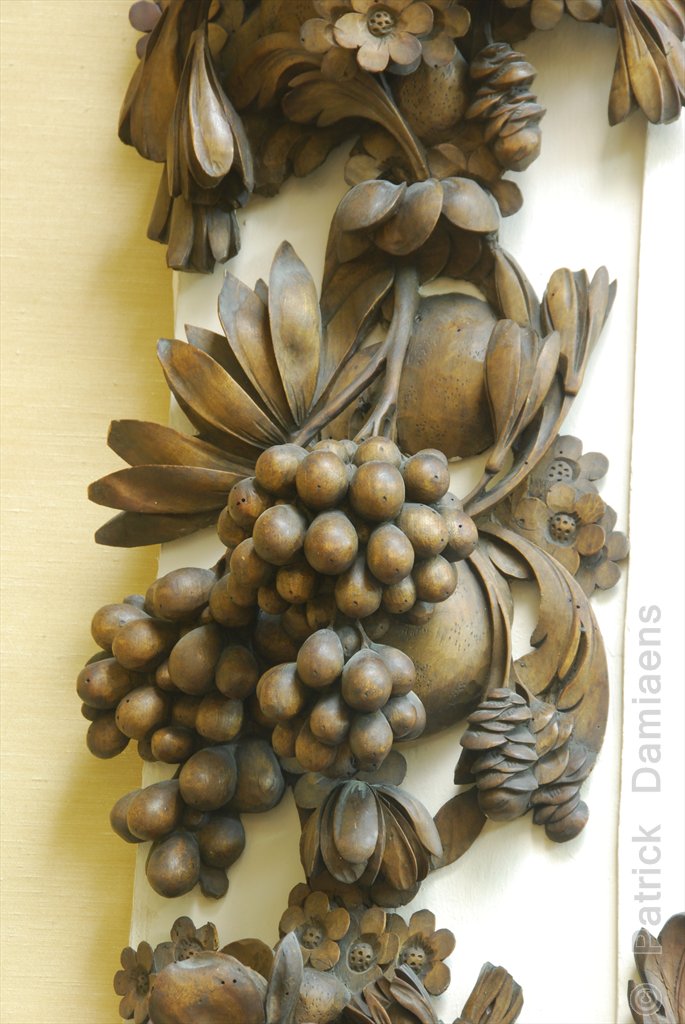
When visiting the museum I noticed that the collection of 18th century Liège style furniture and 17th century decorative art has been put back in order. Thanks to this new set up an extraordinary high-relief carving  out of lime wood became the eye-catcher of the room. This beautiful piece of art reminded me of the work of the English woodcarver Grinling Gibbons (17th century), who created brilliant woodcarvings in his time.

The sculpture below might be the work of Belgian woodcarver Peter Van Dievoet (Brussels, 1661-1729). For a short period of time Van Dievoet labored in the workshop of Gibbons in London but returned to Brussels after the glorious revolution in 1688.

Observe this magnificent piece of craftsmanship


Grinling Gibbons

Grinling Gibbons (Rotterdam, 4th of April 1648-London, 3rd of August 1721) is considered to be one of the most influential and finest woodcarvers in the history of the United Kingdom. In spite of his recognition, very little is known about his youth, training and further life. But what we do know is that his mastership took the art of woodcarving to the next level.


Jubelparkmuseum, Brussels

The Jubelparkmuseum: for the most of us unknown but a true recommendation for everyone who loves art.


For many (incl. foreign tourists) an unknown museum, but a wonderful collection, a real must.


https://www.patrickdamiaens.info


Friday, 17 August 2012

GRINLING GIBBONS STYLE OF CARVING | FOLIAGE CARVING IN LIMEWOOD | HIGH-RELIEF WOODCARVING


PATRICK DAMIAENS,
This is a place where the visitors are confronted with their search for a personal touch and where they have an opportunity to get acquainted with skilled experts, who have turned durability and tradition into their passion.


This carving is a special order for a dentist in Germany. This garland is carved in lime and placed in the library of the customer, above the entrance door. (Over-Door , supraporte).

The library is made in solid oak, the supraporte-carving in limewood, so you get a nice color difference, not abnormal, because It was common in the 17th century English castles.


This is a good example of this technique.

The high-relief carving is made in the carving-style of Grinling Gibbons (17th century)
 
The tools of the dentist are incorporated in this festoon.

First I made a sketch:


Modeling:


And then there are several stages
to achieve the end result:


The initials of the client included in the garland.


CARVED GARLAND

ON YOUTUBE:
 Foiliage carving , supraporte   PART 1


 Foiliage carving , supraporte   PART2


MORE INFO:


https://www.patrickdamiaens.info


Wednesday, 11 July 2012

MASTER WOODCARVER | Ornamental Woodcarver | Patrick Damiaens


Master Craftsman  
Beautiful and highly ornamented Liège-style furniture is still being carved today, thanks to the specialist skills of master Woodcarver Patrick Damiaens.

by Denzil Walton

Patrick Damiaens Ornamental woodcarver
 In the 17th century the Belgian town of Liège became highly prosperous due to its coal mining, metal processing and glass refining industries. It evolved into a fashionable residence for princes, aristocracy and wealthy merchants who had money to spend on lavish, expensive carved furniture. 
The best craftsmen from the surrounding region were invited to work in Liège. The city soon became famous for its Liège-style furniture. It is characterized by beautifully and delicately carved ornaments, usually with a thickness of only 5 mm. 400 years on, Liège-style furniture is still being created and carved to the highest levels of quality. 


From his workshop in Maaseik, Belgium, Patrick Damiaens is a reassuring reminder that even in these days of mass-manufactured furniture, there is still a demand for the traditional skills of a master artisan. 
Damiaens (46) is the only full-time ornamental wood carver in Flanders – the Dutch-speaking half of Belgium – a unique position of which he is immensely proud. “There are a few part-timers and hobbyists in Flanders, but no-one who earns his living doing what I do,” he says.

Carved panelling
What he does is certainly impressive. He works in close cooperation with four colleagues: a staircase-maker, two cabinet-makers and a furniture restorer. 

Between them they turn planks of rough French oak into the most stunningly attractive cupboards, chests of drawers, wardrobes, door frames, staircases, stereo cabinets and decorative panels. “In fact, if you have the budget, we could make and decorate virtually any item of furniture,” Damiaens exclaims enthusiastically.

Liege style furniture

To make an item of Liège-style furniture is a highly complex process. The preparatory technical drawings can take a full month, as every item of furniture decorated by Damiaens is unique and requires a totally new set of drawings. 
His first task is to make a rough sketch of the pattern, which might be based on an original item of furniture or created uniquely by Damiaens himself and drawn in the Liège-style. 

This is then presented to the customer, and after any necessary amendments are made, the final technical drawing is redrawn on tracing paper and pinned to the selected panel of wood. The design is then transferred onto the wood, which in most cases is French oak.
The next stage is the only time that Damiaens uses a machine (apart from one to sharpen his tools). He skilfully manipulates an electric milling machine to remove the bulk of the wood surrounding the design, after which the actual hand carving can begin.

Damiaens first uses a home-made scraper to remove the rough edges and excess wood missed by the milling machine, before bringing his vast collection of Swiss-made razor-sharp wood carving chisels into action. Once the carving is completed, the panel is returned to the cabinet-maker who treats it and incorporates it into the intended item of furniture.
Grinling Gibbons Style of Carving

 One reason why Damiaens likes his job is the variety of projects he is asked to undertake. As well as the larger items of furniture which take a year to complete, he carves and decorates a range of smaller items. At the end of a long working day he tries to find time to work on projects for his own house. He is currently building and decorating new kitchen cabinets.
Grinling Gibbons High-relief carving

 As to the future, Damiaens likes to set himself new carving challenges, his latest being to work in the style of Grinling Gibbons, one of his heroes. “Working mostly in lime wood, Gibbons is particularly well-known for his exquisite cascades of flowers, fruit and leaves, which were applied to paneling, furniture, walls and even chimneys,” explains Damiaens. “So detailed were his carvings that in certain light they look natural and lifelike, and have been likened to lacework. I think he is the finest wood carver of all time.”

By Denzil Walton
 More information : www.patrickdamiaens.info