Welcome to my Blog
This is a place where the visitors are confronted with their search for a personal touch and where they have an opportunity to get acquainted with a skilled expert, who has turned durability and tradition into a personal passion.
I hope this will become a valued and rich source of inspiration and knowledge. Please Leave comments and enjoy your visit. Please note text and pictures on this blog are Copyright protected.

Showing posts with label 'Historic plaster ornaments'. Show all posts

Thursday, 25 January 2024

Casting workshop of the Royal Museums of Art & History in Brussels | Art & History Museum Brussels | Plaster Casts | KMKG in Brussels

Casting workshop of the Royal Museums of Art & History in Brussels | Art & History Museum Brussels | Plaster Casts | KMKG in Brussels
Casting workshop of the Royal Museums of Art & History in Brussels
 | Art & History Museum Brussels 


Plaster sculptures, casts and bas-reliefs

Casting workshop of the Royal Museums of Art & History in Brussels  

KMKG in Brussels

15 October 2023, it had been eight years since my last visit to the Royal Museum of Art and History's castings workshop in Brussels ( Now "Art & History Museum") , a well-established museum founded in the 19th century and this during the reign of King Leopold II. My very first visit to the workshop was in 1990, which I remember very well and have continued to return at regular intervals.

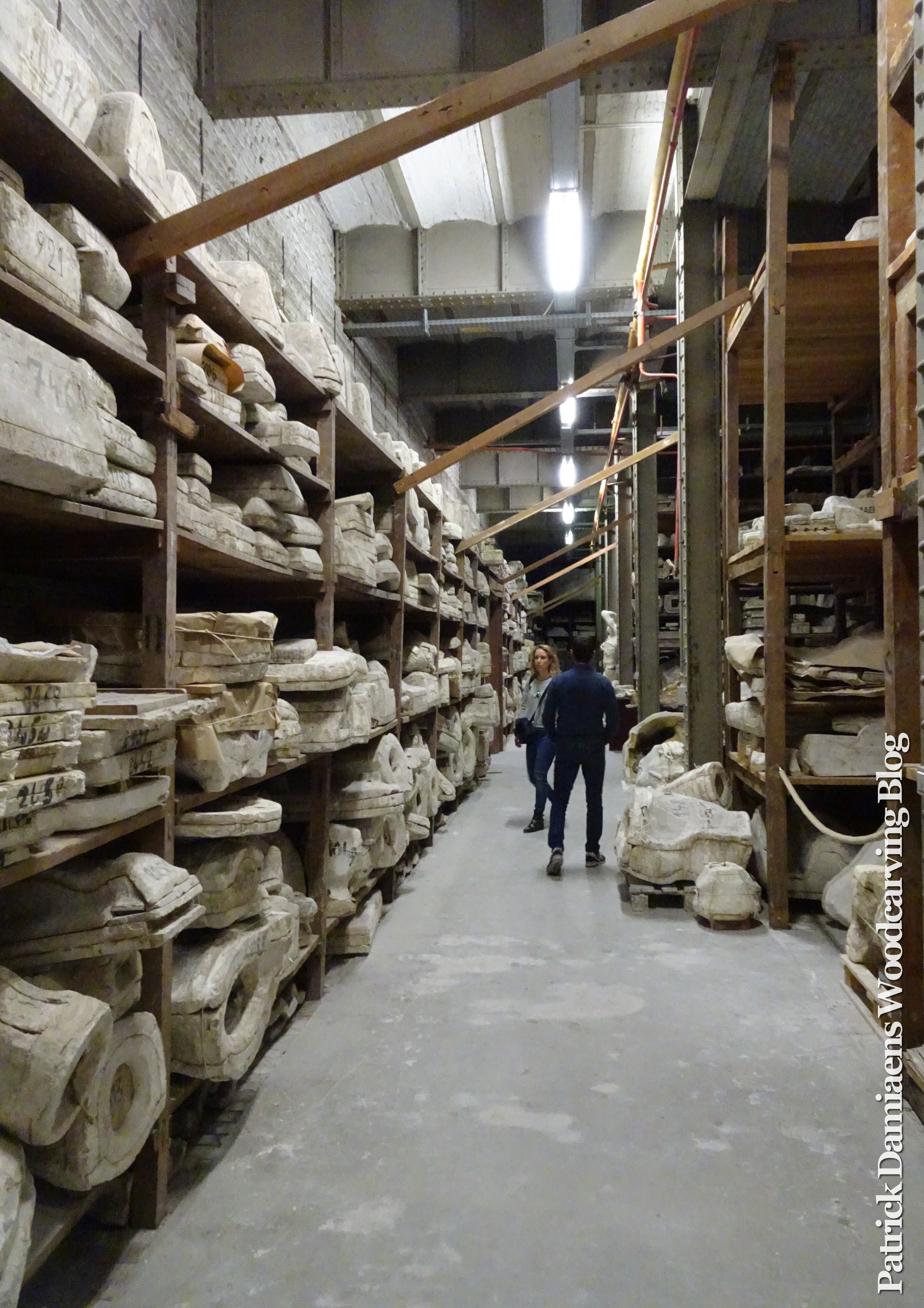
The Royal Museums of Art and History's casting workshop manages and commercially exploits a collection of some 5,000 casts of works of art dating from prehistory to the 18th century. Due to high demand, waiting times of up to two years are natural.

Specialised craftsmen and volunteers make each cast using ancient techniques, and that both in casting the casts and in patination. Take a look at that production process and the unique collection in the museum's catacombs. 

By offering casts for sale, the studio also helps promote art. A selection of small specimens is in stock. Larger ones, such as busts, full-length statues and reliefs, can be ordered. Why not be charmed? I myself bought a print of the eye of Michelangelo's David that day. Price 54 euros. Plaster models are extremely important for the woodcarver, serving as examples or inspiration for carving ornaments in wood.

Casting workshop of the Royal Museums of Art & History in Brussels | Art & History Museum Brussels | Plaster Casts | KMKG in Brussels

Casting workshop of the Royal Museums of Art & History in Brussels | Art & History Museum Brussels | Plaster Casts | KMKG in Brussels

Casting workshop of the Royal Museums of Art & History in Brussels | Art & History Museum Brussels | Plaster Casts | KMKG in Brussels

Casting workshop of the Royal Museums of Art & History in Brussels | Art & History Museum Brussels | Plaster Casts | KMKG in Brussels

Casting workshop of the Royal Museums of Art & History in Brussels | Art & History Museum Brussels | Plaster Casts | KMKG in Brussels

Casting workshop of the Royal Museums of Art & History in Brussels | Art & History Museum Brussels | Plaster Casts | KMKG in Brussels

Casting workshop of the Royal Museums of Art & History in Brussels | Art & History Museum Brussels | Plaster Casts | KMKG in Brussels

Casting workshop of the Royal Museums of Art & History in Brussels | Art & History Museum Brussels | Plaster Casts | KMKG in Brussels

Casting workshop of the Royal Museums of Art & History in Brussels | Art & History Museum Brussels | Plaster Casts | KMKG in Brussels


Casting workshop of the Royal Museums of Art & History in Brussels | Art & History Museum Brussels | Plaster Casts | KMKG in Brussels

Casting workshop of the Royal Museums of Art & History in Brussels | Art & History Museum Brussels | Plaster Casts | KMKG in Brussels


Casting workshop of the Royal Museums of Art & History in Brussels | Art & History Museum Brussels | Plaster Casts | KMKG in Brussels

Casting workshop of the Royal Museums of Art & History in Brussels | Art & History Museum Brussels | Plaster Casts | KMKG in Brussels

Casting workshop of the Royal Museums of Art & History in Brussels | Art & History Museum Brussels | Plaster Casts | KMKG in Brussels
https://www.patrickdamiaens.info


Saturday, 12 March 2016

Canons Regular of the Order of the Holy Cross | ROCOCO Church Interior | Church in the historical Town of MAASEIK | A Croisiers Church in Belgium

The CROISIERS CHURCH
Order of the Holy Cross, Crutched Friars

Canons Regular of the Order 
of the Holy Cross
in the historical city centre of MAASEIK
A church interior in Rococo


We’ve already dedicated many blog items to incredibly beautiful and interesting museum collections, castles and religious buildings, which could mostly be found abroad. However, in this blog item, we’re staying a bit closer to home, namely in my own hometown, the city of Maaseik. 
In the historical city centre, we pay a little visit to the Church of The Canons Regular of the Order of the Holy Cross, commonly called Crosiers, also known as Saint-Jacob’s Church, situated in the Bosstraat. It is endowed with one of the most beautiful church interiors in Rococo in the entire province of  Belgian Limburg. 

A church in the historical Town of MAASEIK

Canons Regular of the Order of the Holy Cross

The Order of the Holy Cross was founded in the first half of the thirteenth century. These “Brethren of the Cross”, as the first Crutched Friars called themselves, wandered around preaching the word of God, and wherever they lingered, a small religious community arose. Most of these communities didn’t last long though.
Yet, in the principality of Liège, where a devout following of the Holy Cross had existed for quite some time already, certain communities managed to survive. They settled near the edge of a town and/or kept in close touch with the noblemen who owned the land along the trade routes. 
These noblemen built a chapel for themselves and a hospital for weary travellers and pilgrims and were always looking for priests to celebrate mass and look after the hospital.
In 1248, a number of communities of the Brethren of the Cross decided to join into one order of regular canons. 
That same year, the pope approved of the creation of the order, thus establishing the Order of the Holy Cross. 
By the end of the thirteenth century, the order consisted of quite a few monasteries in the principality of Liège and the rest of “Belgium”, but also abroad, including in France, Germany, The Netherlands and England. After receiving a number of privileges the legal position of the Order was strengthened, and slowly but surely, the monastery of Huy worked its way up to become the official “headquarters”.

A Croisiers Church in Belgium | Maaseik

In 1767, prior Johannes Henricus Vossen ( †1770) commissioned the construction of the Saint-Jacob’s Church. The new church replaced the old Saint-Jacob’s chapel, a late gothic building that was torn down. This old building was described in ‘Les Délices du Pays de Liège’: “The church is beautiful and appealing, even though it was erected in the style of the former period, and ends in a round vault which is supported. The nave is lower and, as with the side aisle, completely plastered. The interior as a whole is quite lovely and is adorned with four painted and gilded altars in Corinthian style”. The new Saint-Jacob’s Church, which was built by Josef Couven from Aachen, is a church with a single nave in the style of Louis XV or Rococo.

Construction of the present church

On the eve of the French Revolution, Maaseik counted no less than 6 religious orders. Their monasteries were located inside the city walls, but outside the city centre, at the edge of town near the city gates. This allowed each of the monasteries to map out their own territory, as it were. The monastery churches did not have a church tower, but had a roof-turret instead. A small steeple with a bell in it was more than enough for the monastery and the locals. The Saint-Jacob’s Church of the Crutched Friars still has such a roof-turret. From the outside, this church comes across as quite uninspired and dull. It’s hidden among the rows of houses near the building line and has become a part of the street façade.
The church has an arched portal in a rectangular block-shaped frame, consisting of limestone and adorned with a keystone and a stalactite-shaped stone. The keystone bears the chronogram “in CrUCe MunDI saLUs” (the cross holds the sake of the world).

The entrance 

“in CrUCe MunDI saLUs”

In 1797, the monastery of the Crutched Friars was abolished by the French and the monastery buildings were torn down. The church, however, joined the parish of Maaseik. In 1856 it was sold to the Crutched Friars, who had returned at that time. 

Rococo interior

The beautiful Rococo interior, with adorable stucco and plastering, contrasts sharply with the exterior. The interior of the Church of the Crutched Friars is exactly the reason why this is one of the most beautiful churches in the province of Limburg. The vaulting consists of vaulting cells in between the ribs, which are supported by columns with Doric and Ionic capitals.
The chancel area is covered by fan vaulting. In the stucco in between the arches we see the devotions of the Crutched Friars of Maaseik.

Doors, Rococo style


Rocaille patterns, characteristic of the Rococo style, were applied in abundance on the vaulting, façades, the arcades and the furniture. Pay particular attention to the large variety of patterns, which were all applied on site in the wet stucco.


Chancel

The sober wooden baroque altar originates from the old church. The altar of St-Peter’s cathedral in Rome, with its four columns and canopy, served as a model for this sort of altars stemming from the 17th and 18th century. Due to a lack of space, the front columns were moved to the back and ended up next to the rear columns (Corinthian columns). A broken arch consisting of three segments replaces the large canopy.

The altar piece is a magnificent painting attributed to the Antoon van Dijck School. It is a depiction of the crucified Christ with Mary Magdalene and a Crutched Friar (Theodorus van Celles, the founder of the Crutched Friars or Augustinus Nerius, the master at that time) in an ecstatic pose with staff, mitre and sword. The cross of the order and the proverb “In Cruce Salus” (the cross holds the sake) complete the tableau.

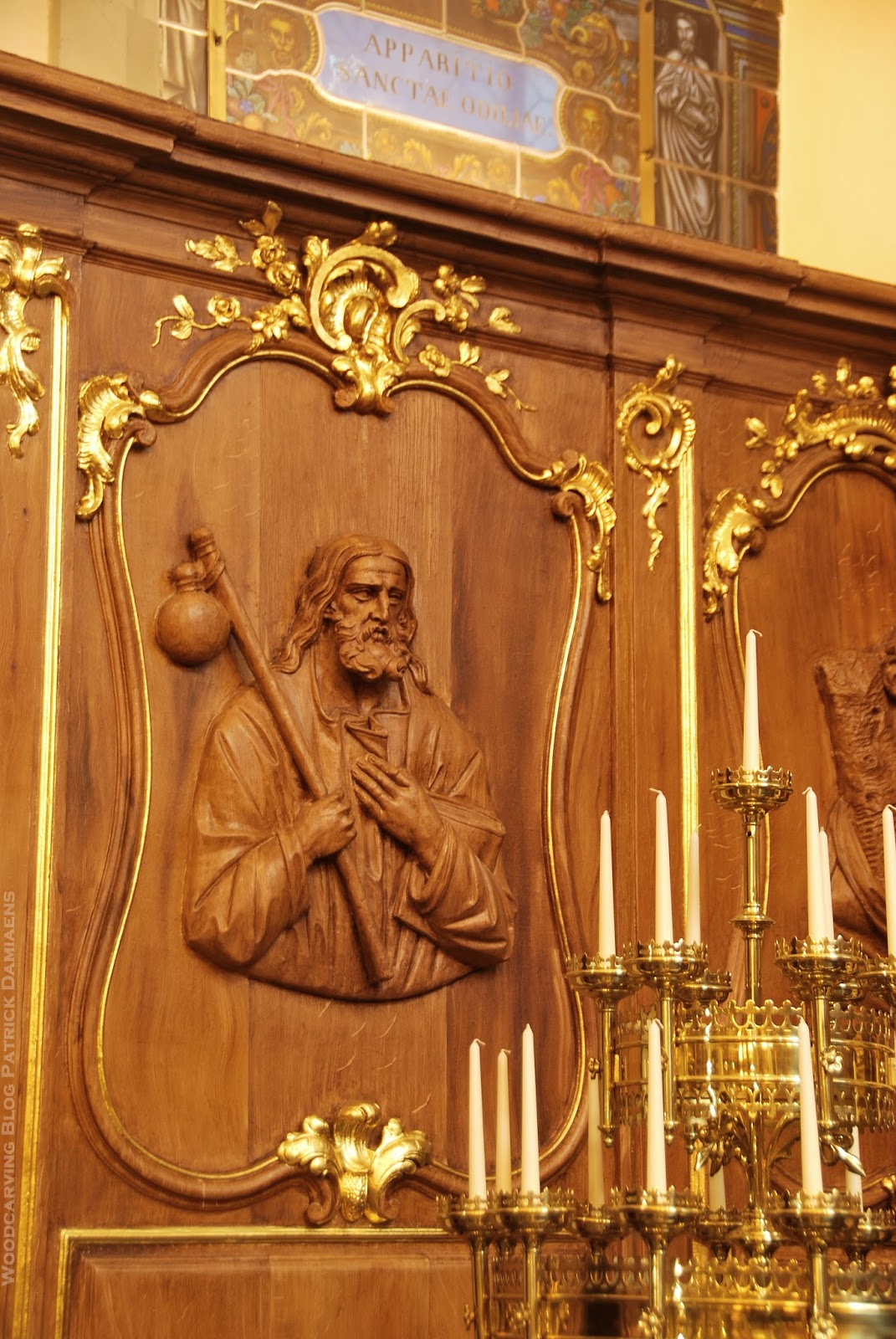
On either side of the altar, two cabinets are mounted on the wall, holding relics of the Holy Odilia. The stained-glass window to the left of the altar we see the apparition of the Holy Odilia to the Crutched Friar Joannes van Eppa, who was commanded by her to bring her relics from Cologne to Huy.


On either side of the chancel and in the back of the church, we find oak doors with charming examples of woodcarving, not of the highest standard, but definitely worth mentioning, notably the flower and leaf motifs on the structural parts of the doors and the shell motifs on the panels.

Organ railing, Rococo style church interior

Rood loft

The present organ dates back to the end of the 19th century, but a positive was built into the organ railing, which probably originates from the earlier Saint-Jacob’s Church. The railing is richly adorned. It has depictions of flutes, clarinets, oboes, violins, kettledrums, etc. in stucco. 
The entire structure, hanging from fluttering ribbons and wreathed with flowers and leafs, shows great craftsmanship. On either side the organ is adorned with statues of the Holy Augustine and the Holy Helena, who’s presumed to have held a cross in her left hand, originally.


During restorations in 2008-2009, the church wasn’t just repainted in its original colours, but also remarkably embellished. For example, the 19th century pulpit, parts of which served as an altar and others as a lectern for several years, can now be admired in its original place and in its original shape, no less.


Here are a few pictures of the stucco! 
Adorned by Mertens (native of Antwerp), the chancel with busts of the 12 apostles on either side, stucco with an elegant frame in neo Rococo style. 


ROCOCO Church Interior


https://www.patrickdamiaens.info

Our FB Page

Tuesday, 4 December 2012

PLASTER CASTS | PLASTER ORNAMENTS | CASTS OF ORNAMENTS | Historic plaster ornaments | PLASTER CASTS AND STATUES

The plaster-cast workshop of the Museum
Patrick Damiaens

Ornamental Woodcarver -
Historic plaster ornaments

Plaster casts of historical ornaments and plaster statues

The Museum of Art and History 
in Brussels (The Cinquantenaire )


The plaster-cast workshop of the Cinquantenaire Museum of Art and History in Brussels, the visit.

As you’ve undoubtedly noticed in other blog-items, the search for new ornamental models, designs and inspiration plays an important role in becoming an excellent ornamental woodcarver.

Sketches and photographic material are an important source of knowledge, the latter of which has become increasingly more important in the gathering of knowledge thanks to the invention of the digital camera. 


Tangible models from all kinds of material are, however, still the first and foremost form of inspiration. Seeing as wooden, stone or clay models aren’t easy to come by, plaster ornaments, casts of ornaments, plaster casts, statues and models are ideal substitutes for a woodcarver.


Wonderful plaster ornaments ,models and examples


Historic plaster ornaments


These Historic plaster ornaments, statues and casts hold great educational value. They allow the ornamentalist to truly observe the design and character of a certain stylistic period or to discover the typical characteristics of that period.

Every now and again I travel to Brussels and each time I’m there, I traditionally pay a visit to the Cinquantenaire Museum. My absolute favourite is the Museum of Art and History, which is Belgium’s largest museum. 

4000 different molds of plaster casts, plaster replicas and plaster ornaments 


Bas-relief  plaster

The Cinquantenaire Museum
 
In the Cinquantenaire Museum you can literally walk from prehistoric celts to Egyptian mummies. You can nose about for delftware and take a step back to gaze at the impressive Brussels tapestries.

One minute you can wander off to the orient and walk between the Asian Buddhas only to find yourself in a completely different part of the world the next, admiring a giant Easter Island statue. 

Not to mention the lovely collection of Belgian art nouveau…in short, in the Cinquantenaire Museum you can travel across time and continents, from prehistoric times to the 20th century. It’s a delight to lose yourself in.

The museum has a section called ‘Atelier de Moulages’ or plaster-cast workshop (free admission). The people are really friendly and you can actually purchase plaster models, casts of ornaments, plaster statues and bas-reliefs at affordable prices.


For information on how to find the workshop, it’s best to turn to the museum’s inquiry/ticket office. Admission to the plaster-cast workshop is free. The educational and cultural service of the Cinquantenaire Museum organizes tours on request.


Main entrance of the Museum
The Royal Museums of Art and History in Brussels
Collections


In the Cinquantenaire Museum,you can see national archaeological artefacts from prehistory to the age of the Merovingians, as well as finds from Egypt, the Near East, Iran and Classical Antiquity. 

Among the star attractions are the collections of Egyptian sarcophagi and Greek vases, the great mosaic floor from Apamea and the model of Ancient Rome. 

There are also non-European art treasures from China, South-east Asia, Central Asia, the cultural world of Islam, America and Oceania. Particularly famous is the collection of pre-Columbian art and another eye-catcher is the colossal statue from Easter Island. 

There is also a representative selection of European decorative art, ranging from Romanesque Art to Art Deco. Among the collections not to be missed are the Mosan liturgical treasures, the tapestries, the retables, the glassware and the Art Nouveau figures.

Indeed, some of the art treasures in this museum are right out of the top drawer.

Museum website


The Plaster-cast Workshop


The Plaster-cast Workshop was established in the nineteenth century during the reign of King Leopold II. It houses a collection of more than 4 000 casts of works of art dating from prehistoric times to the eighteenth century. 

In reproducing those works of art, the workshop’s specialized craftsmen employ traditional techniques in both the casting and the patination. 
To give you an idea of their work, we have made a selection from the various casts that they have made.

The Museum of art and history in Brussels the plaster-cast Workshop


Casting Workshop of the Museum, plaster replicas and bas-reliefs

By offering casts at reasonable prices, the workshop helps to promote art. 
The larger examples, such as busts, full-length statues, reliefs, etc., have to be ordered, but there is a good stock of the smaller examples. Indeed, there is something to suit everyone’s pocket and taste. 

Prices can be found on the pdf file and some casts are on sale in the Cinquantenaire Museum shop.

Admission to the workshop is free and the Educational and Cultural Service of the Cinquantenaire Museum organizes guided tours on request.

More information on plaster casts, casts of ornaments and historical plaster ornaments.
Plaster-casts Workshop


Opening hours
Tuesdays to Fridays : 9:30 a.m. - 12:00 a.m. en 1:30 p.m. - 4:00 p.m.
Closed on Weekends, Mondays, Feast-days, 1 January, 2, 15 en 16 November, and from 25 December to 31 December.