REALISATION, CUSTOM-MADE WOODCARVING AND ORNAMENTS. REPRODUCTION OF LIEGE STYLE FURNITURE AND HERALDIC SCULPTURES.
Welcome to my Blog This is a place where the visitors are confronted with their search for a personal touch and where they have an opportunity to get acquainted with a skilled expert, who has turned durability and tradition into a personal passion.I hope this will become a valued and rich source of inspiration and knowledge. Please Leave comments and enjoy your visit. Please note text and pictures on this blog are Copyright protected.
Showing posts with label 'plaster ornament molds'. Show all posts
Showing posts with label 'plaster ornament molds'. Show all posts
Casting workshop of the Royal Museums of Art & History in Brussels | Art & History Museum Brussels
Plaster sculptures, casts and bas-reliefs
Casting workshop of the Royal Museums of Art & History in Brussels
KMKG in Brussels
15 October 2023, it had been eight years since my last visit to the Royal Museum of Art and History's castings workshop in Brussels ( Now "Art & History Museum") , a well-established museum founded in the 19th century and this during the reign of King Leopold II. My very first visit to the workshop was in 1990, which I remember very well and have continued to return at regular intervals.
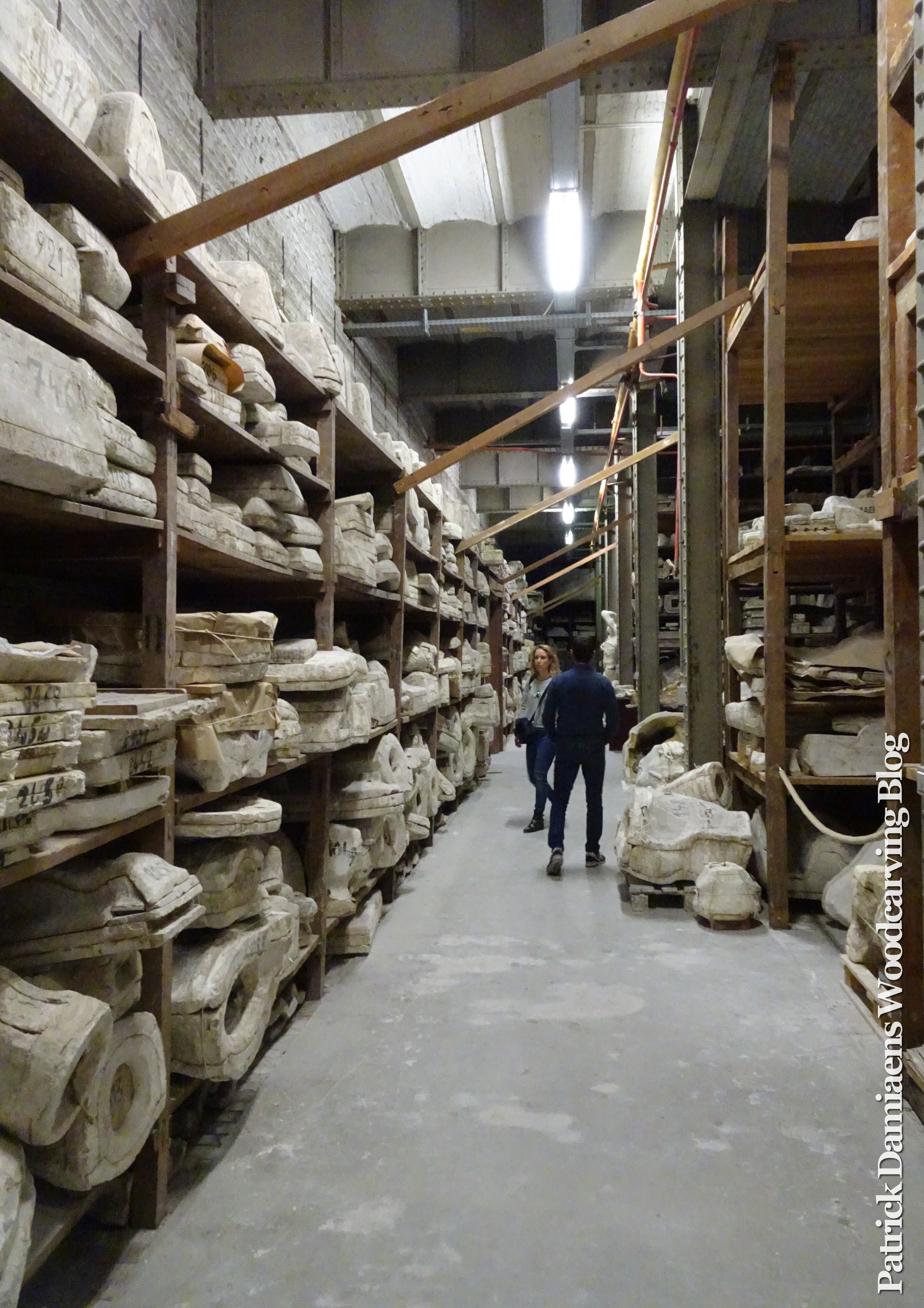
The Royal Museums of Art and History's casting workshop manages and commercially exploits a collection of some 5,000 casts of works of art dating from prehistory to the 18th century. Due to high demand, waiting times of up to two years are natural.
Specialised craftsmen and volunteers make each cast using ancient techniques, and that both in casting the casts and in patination. Take a look at that production process and the unique collection in the museum's catacombs.
By offering casts for sale, the studio also helps promote art. A selection of small specimens is in stock. Larger ones, such as busts, full-length statues and reliefs, can be ordered. Why not be charmed? I myself bought a print of the eye of Michelangelo's David that day. Price 54 euros. Plaster models are extremely important for the woodcarver, serving as examples or inspiration for carving ornaments in wood.
As was
already mentioned in other blog items, plaster models are very important to ornamental
woodcarvers.
A
plaster model, as the name already suggests, is a three-dimensional
reproduction of what a certain ornament looks like. For example, they
give the ornamental woodcarver a realistic and tangible feel of the design and
character of a certain style or period.
Since
certain ornaments are typical for a certain style or period, this helps to
ascertain the period of a piece of furniture or a building.
My workshop
Due to
their design and tangible presence, models of ornaments play an important role
in the education of any decent ornamental woodcarver. Even the most seasoned
woodcarver can still draw a lot of inspiration from these models.
An ornamental woodcarver is therefore always looking for new models. Whenever
I’m abroad, visiting a fellow-woodcarver, I automatically pay full attention to
their personal collection of plaster models and other plaster casts that adorn
the walls of their workshop.
This represents an enormous wealth of information, which whets the appetite
for taking on new woodcarving challenges.
Especially when I visit the
woodcarver workshop “l’Ecole Boulle” in Paris, where the walls are absolutely
plastered with beautiful “goodies”, I’m completely overtaken by this greedy
sensation, making me think “I want that one” or “how I wish that one was mine”.
The only solution at a time like this is to take as many pictures as possible.
This
helps you to create an extensive educational archive; a useful personal archive
that you can consult whenever you want.
l'école Boulle in Paris
As I
mentioned earlier, there is no substitute for “the real thing”. Plaster
ornaments and other plaster casts are essential to the education of any
woodcarver, who takes his profession seriously.
Sketches
and photographic material (especially taken with a digital camera) are starting
to play a bigger role and have become increasingly more important in the quest
for knowledge, but are by no means real substitutes for plaster models.
l'école Boulle in Paris
Why did
ornamental woodcarvers start using plaster ornaments?
Back in
the day, when a woodcarver was commissioned to create a decoration or ornament,
the design was first moulded in clay and shown to the client so that he or she
could decide whether or not the design was to his or her liking.
One
would think that a woodcarver could basically use this clay model to start
working on the wooden ornament. Unfortunately, the clay would dry out and start
cracking. Pieces would fall off, making this a very inefficient model to use: not
then, not now, not ever. The
solution was finally found by first making a mould of the clay model, which was
then filled with plaster: the plaster model was born.
This was
more durable and because of the hardness of the plaster, the woodcarver was
able to take measurements for his workpiece. This method was also used to
create basic ornaments in plaster, to serve as a model and a source of
inspiration for apprentices.
This
work method is still very relevant and therefore I also apply it during the education
of my students.
In this
blog item, I introduce you to the different stages of making a leaf-shaped plaster
model.
OrnamentDrawing
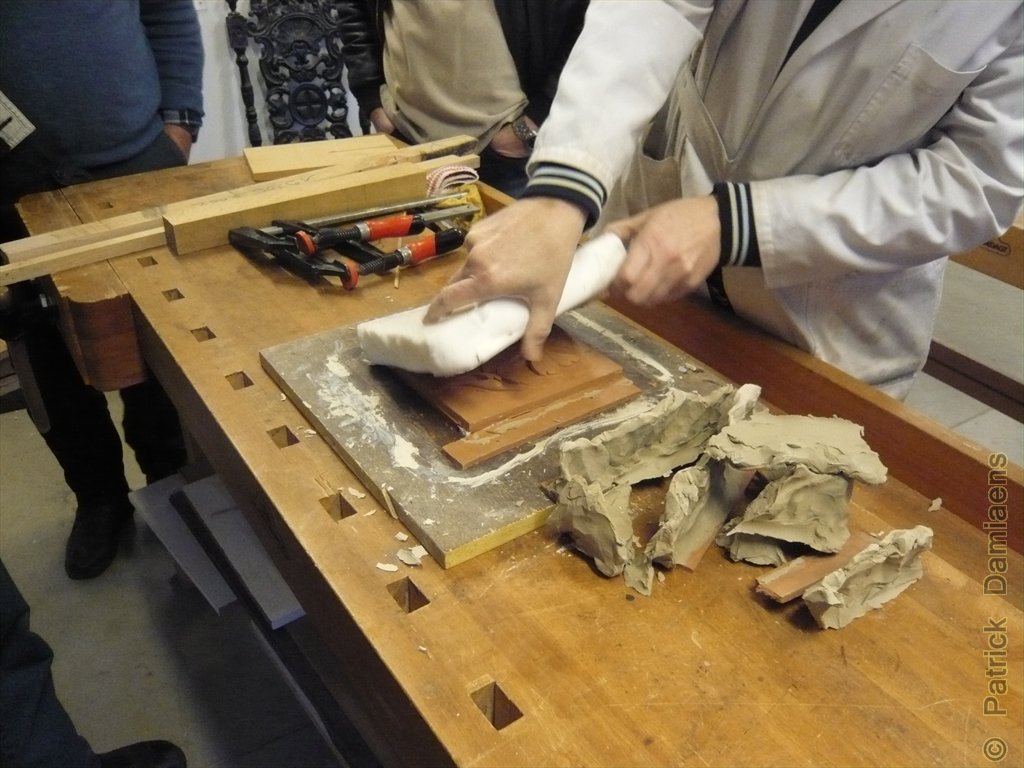
Themodelingof the ornamentin clay
Making a silicon mold
Thesilicon moldis ready
Casting aplasterornament
Theleaf-shapedornamentis finished
Course
in woodcarving – ornamental carving
I’ve been teaching professional courses on the subject of the creation and
carving of ornaments for 15 years now. This class – a course on “woodcarving -
Liège ornaments” – has been successfully taught in Tongeren, (Limburg, Belgium)
for many years now.
Every
assignment or technique is executed in wood by me personally. These wooden
panels or models are then used to create silicon moulds, so that the student
has the opportunity to make his own plaster cast to serve as an example when
working on his assignment in wood. The plaster casts are an important source of
inspiration for the student, seeing as woodcarving is not only learned by doing,
but also by observing and constantly being confronted with models and designs.
For
the moment, we have approximately 150 different models. Should you be
interested in acquiring one of our educational ornaments,
please feel free to contact us.
Plaster casts of historical ornaments and
plaster statues
The Museum of Art and History
in Brussels (The Cinquantenaire )
The plaster-cast
workshop of the Cinquantenaire Museum of Art and History in Brussels, the visit.
As you’ve undoubtedly noticed in other blog-items, the search for new ornamental
models, designs and inspiration plays an important role in becoming an
excellent ornamental woodcarver.
Sketches and photographic material are an important source of knowledge, the
latter of which has become increasingly more important in the gathering of
knowledge thanks to the invention of the digital camera.
Tangible models from
all kinds of material are, however, still the first and foremost form of
inspiration. Seeing as wooden, stone or clay models aren’t easy to come by,
plaster ornaments, casts of ornaments, plaster casts, statues and models are
ideal substitutes for a woodcarver.
Wonderfulplaster ornaments ,modelsand examples
Historic plaster ornaments
These Historic plaster ornaments, statues and
casts hold great educational value. They allow the ornamentalist to truly
observe the design and character of a certain stylistic period or to discover
the typical characteristics of that period.
Every now and again I travel
to Brussels and each time I’m there, I traditionally pay a visit to the
Cinquantenaire Museum. My absolute favourite is the Museum of Art and History, which
is Belgium’s largest museum.
In the Cinquantenaire Museum
you can literally walk from prehistoric celts to Egyptian mummies. You can nose
about for delftware and take a step back to gaze at the impressive Brussels
tapestries.
One minute you can wander off to the orient and walk between the
Asian Buddhas only to find yourself in a completely different part of the world
the next, admiring a giant Easter Island statue.
Not to mention the lovely
collection of Belgian art nouveau…in short, in the Cinquantenaire Museum you
can travel across time and continents, from prehistoric times to the 20th
century. It’s a delight to lose yourself in.
The museum has a section called ‘Atelier de Moulages’ or plaster-cast workshop
(free admission). The people are really friendly and you can actually purchase
plaster models, casts of ornaments, plaster statues and bas-reliefs at
affordable prices.
For information on how to find the workshop, it’s best to turn to the
museum’s inquiry/ticket office. Admission to the plaster-cast workshop is free.
The educational and cultural service of the Cinquantenaire Museum organizes
tours on request.
Main entrance ofthe Museum
The Royal
Museums of Art and History in Brussels
Collections
In the Cinquantenaire Museum,you can see national
archaeological artefacts from prehistory to the age of the Merovingians, as
well as finds from Egypt, the Near East, Iran and Classical Antiquity.
Among
the star attractions are the collections of Egyptian sarcophagi and Greek
vases, the great mosaic floor from Apamea and the model of Ancient Rome.
There
are also non-European art treasures from China, South-east Asia, Central Asia,
the cultural world of Islam, America and Oceania. Particularly famous is the
collection of pre-Columbian art and another eye-catcher is the colossal statue
from Easter Island.
There is also a representative selection of European
decorative art, ranging from Romanesque Art to Art Deco. Among the collections
not to be missed are the Mosan liturgical treasures, the tapestries, the
retables, the glassware and the Art Nouveau figures.
Indeed, some of the art
treasures in this museum are right out of the top drawer.
The Plaster-cast Workshop was established in the nineteenth century during
the reign of King Leopold II. It houses a collection of more than 4 000 casts
of works of art dating from prehistoric times to the eighteenth century.
In
reproducing those works of art, the workshop’s specialized craftsmen employ
traditional techniques in both the casting and the patination. To give you an
idea of their work, we have made a selection from the various casts that they
have made.
The Museumof art andhistory in Brussels theplaster-cast Workshop
CastingWorkshopof the Museum,plaster replicasand bas-reliefs
By offering casts at reasonable prices, the workshop helps to promote art. The larger examples, such as busts, full-length statues, reliefs, etc., have to
be ordered, but there is a good stock of the smaller examples. Indeed, there is
something to suit everyone’s pocket and taste.
Prices can be found on the pdf
file and some casts are on sale in the Cinquantenaire Museum shop.
Admission to the workshop is free and the Educational and Cultural Service
of the Cinquantenaire Museum organizes guided tours on request.
More information on plaster casts, casts of ornaments and historical plaster
ornaments. Plaster-casts Workshop
Opening hours
Tuesdays to Fridays : 9:30 a.m. - 12:00 a.m. en 1:30 p.m. -
4:00 p.m.
Closed on Weekends, Mondays, Feast-days, 1 January, 2, 15 en
16 November, and from 25 December to 31 December.




.jpg "Casting workshop of the Royal Museums of Art & History in Brussels | Art & History Museum Brussels | Plaster Casts | KMKG in Brussels")