Welcome to my Blog
This is a place where the visitors are confronted with their search for a personal touch and where they have an opportunity to get acquainted with a skilled expert, who has turned durability and tradition into a personal passion.
I hope this will become a valued and rich source of inspiration and knowledge. Please Leave comments and enjoy your visit. Please note text and pictures on this blog are Copyright protected.

Showing posts with label 'classic paneling'. Show all posts

Saturday, 8 August 2026

Oval Office fireplace | Incorrect placement of decorative ornaments | Ornament for the fireplace in the White House in Washington.


Oval Office fireplace |  Incorrect placement of decorative ornaments |  Ornament for the fireplace in the White House in Washington.

Ornament for / in a fireplace 
at the White House in Washington.

Oval Office fireplace

It struck me – it must have been sometime in March 2025 – that whenever US President Donald Trump sat in front of a fireplace at the White House (Washington), either alone or with world leaders, gilded ornaments were prominently visible in the background (in or in front of a fireplace).

As I follow world news and related visual material (particularly in connection with ornamentation) to some extent, I couldn’t really recall ever having seen this sort of published visual material in the past.

These are two gilded appliqué ornaments, probably made of plaster, plastic or resin, fitted beneath or, rather, within (?) the fireplace. Why am I mentioning this (?) – why this particular spot?

I have never before seen this in a fireplace – and I have had the pleasure of admiring many, … truly many fireplaces from all stylistic periods over the years in historic buildings – but I have never seen this method of decoration in this specific location or in this manner.

A new US President? Apparently that means ‘he’ is also allowed to redecorate the interior of his residence in Washington. But I do have my doubts as to whether it’s all been done properly; in any case, it’s in poor taste.

But I wouldn’t have expected anything else from this US President; the décor of his private floors in his ‘Trump Tower’ in New York has probably served as a reference – in a word, bling-bling and plenty of kitsch.

Oval Office fireplace |  Incorrect placement of decorative ornaments |  Ornament for the fireplace in the White House in Washington.


Tasteless

If you examine these gilded appliqué ornaments in detail and compare them with one another to spot any differences, you can be certain that they are not unique pieces, but that they have been cast, most likely in plaster, plastic or resin.

Judging by the carving technique, execution and finish, they were made in Asia; these ornaments look European (Régence style period) but the details betray that the maker was not familiar with European style periods – there are too many errors in the composition or in certain elements of the design that an ornamental carver with a European (French) training would never (be allowed to) make.


The correct method

If this ornament were to be used correctly, it could only be positioned horizontally, above a door; this is known as a ‘supraporte ornament’. However, in contrast to its current application (as shown in the photograph of the White House), the wider part of the composition should be on the outer side and both parts should be joined together by a moulding.

This arrangement as a supraporte is rare; usually you see a central motif above a door, but it is not unheard of.

However, this ornament could also be used horizontally on low panelling (wall panelling) measuring 60–70 cm in height.


=>In fact, this decorative motif is intended for vertical use, as is frequently the case in panelling; here too, the lower and upper motifs must be connected by a moulding – they must not appear to be floating.

Below is a photo showing what this fireplace looked like before Trump became President. Biden is pictured in the photo.

Oval Office fireplace |  Incorrect placement of decorative ornaments |  Ornament for the fireplace in the White House in Washington.

Oval Office fireplace |  Incorrect placement of decorative ornaments |  Ornament for the fireplace in the White House in Washington.
www.patrickdamiaens.info


Saturday, 1 August 2015

The CARNAVALET Museum in Paris | 18th century style WOODCARVING | Carved boiserie and paneling | Panelled rooms


Carnavalet in Paris


Carnavalet Museum in Paris
__________________________
____________________

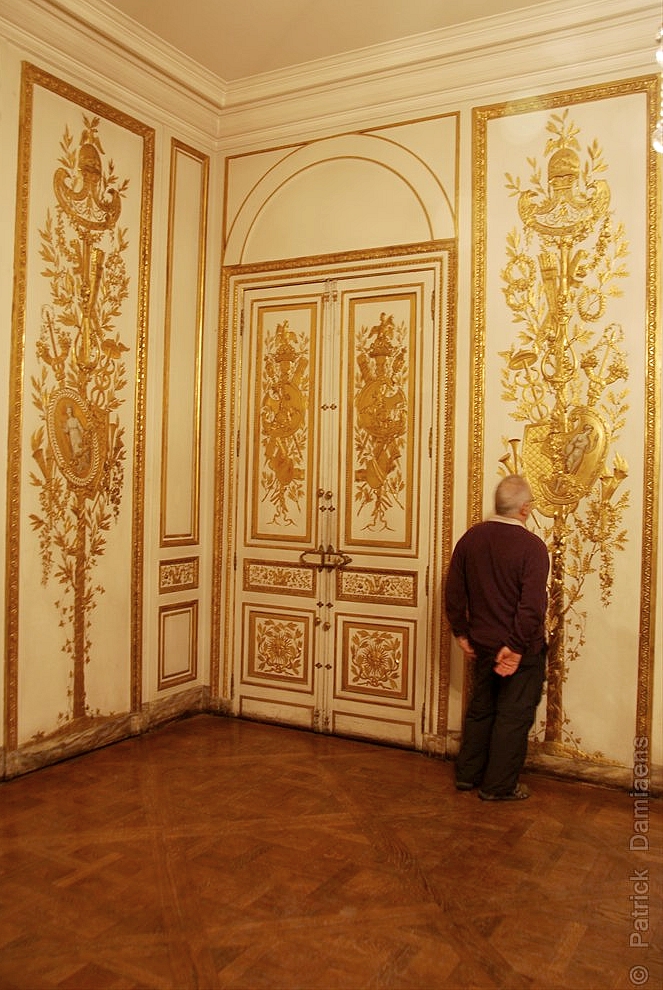
This blog entry is about the visit to the Carnavalet Museum in Paris. A very nice museum  with panelled rooms, boiserie and 17th and 18th century paneling. A  real source of inspiration if you want to see examples of 18th century style woodcarving  and its applications


The Carnavalet Museum is located in the fascinating neighborhood “The Marais”, known for its beautiful mansions, de private “hôtels” (city palaces), but also for the many boutiques, galleries and restaurants.

For anyone who wants to learn more about the rich and turbulent history of Paris, the Carnavalet museum is a must. Carnavalet is also the official museum of the City of Paris.


The collection is chronological and shows the history of Paris, its inhabitants and their troubled times with photographs, paintings and exhibitions.

Some rooms are not open all the time, the schedule with their opening hours hangs at the entrance of the Museum, every day. And something to take into consideration: the access is free of charge.

_______________________________________________
________________________________


The building


The Carnavalet Museum is housed in two adjacent buildings that were known as the Hôtel Carnavalet and the Hôtel Le Peletier de Saint-Fargeau. The entrance to the Museum is located in the main building, the Hôtel Carnavalet from the 16th century. In 1548 Jacques des Ligneris, Paris Parlament chairman ordered the construction of the mansion, known as Hôtel Carnavalet; the construction was completed in 1560. In 1578 the widow of Francois de Kernevenoy bought the property, later known as the Carnavalet building.

During the 17th century thebuilding was expandes and modernized by the “King’s Architect”, Francois Mansart (1598-1666). One of its well-known inhabitants of the Carnavalet was the Parisian aristocrat Madame de Sevigne (1626-1696), wife of the Marquis de Sevigne. She was part of the French nobility and became known as a writer through her letter, which are part of the classics of the French literature.

The Hôtel Le Peletier de Saint-Fargeau, considered a masterpiece of the Renaissance, was built in the mid-16th century. It was originally known as the Hôtel d'Orgeval. It was purchased by Michel Le Peletier and eventually passed to his grandson, Le Peletier de Saint Fargeau (a representative of the nobility in the States-General of 1789).  In 1793, Le Peletier voted for the execution of Louis XVI. In revenge for his voting, the same day of the execution of the King, Le Peletier was assassinated.


Courtyard /gardens


In the center of the small courtyard at the entrance of the Carnavalet Museum is a statue of Louis XIV, the only statue from Louis XIV remained after the French Revolution. The beautiful gardens on the other courtyards are built in a typical formal French style.


Museum

The museum is mainly decorated with sculpted paneling or carved paneling took from another buildings.  Within the two mansions there are particularly room styles that are furnished as in the past. For example, you will find rooms and lounges from the 17th and the 8th centuries; two rooms designed by the renowned classicist architect Nicolas Ledoux. Another highlight is the painted ceiling, made by Charles Le Brun.
I was very impressed by the décor of the Fouguet jewelry (1900). The interior design of the store was made by the famous Czech Art Nouveau designer and painter Alfonso Mucha (1860-1939). Well worth the reconstruction of the ballroom of the Hôtel de Wendel, from the early 20th century.

 Panelled Rooms


Besides the historical rooms, there are also objects from the Roman era, antique maps and paintings depicting Paris through the years are exhibit. Around 2,600 paintings; 20,000 drawings and 300,000 engravings; 2,000 sculptures and 800 pieces of furniture are included in the collection of the Museum and together with thousands of other object, are the base of the collection. There are even some rooms decorated with personal items and belongings of some Parisian celebrities, such as Marcel Proust.

The beautiful style rooms with sculpted -carved paneling in Louis-styles are magnificent decorated with many works of art (paintings, drawings, and graphic work), applied art and archaeological objects. For those who are only interested in the most important art collections, he better skips this museum.


A visit to this museum is for sure more than worthy.
___________________________
____________________


The museum began to take its present form when the Hôtel Carnavalet was expanded in 1989 when it started using some rooms of the het Hôtel Le Peletier. Within each of the two mansions are entire rooms from certain periods in history on display.

The collection is primary organized chronologically and shows the history of Paris till all the way back to 1789, in more than 100 rooms.


© Text and pictures, Patrick Damiaens
Translation  Lis Alvarado

Website: 
http://www.carnavalet.paris.fr/en/museum-carnavalet


Some pictures from my last visit 
to this charming Parisian Museum (2014).
___________________
_________
 Carved boiserie and paneling | The Carnavalet Museum Paris

Carved Panelling


Carved and gilded panelling |  Boiserie | Carnavalet Paris


Oak carved Panelling

 Panelled Rooms

18th century style WOODCARVING

The CARNAVALET Museum in Paris


18th century style WOODCARVING

The CARNAVALET Museum in Paris

18th century style WOODCARVING


 A book about the carved wall panelling


A book about the carved wall panels or 'Les Boiseries' Musee Carnavalet, for sale in the museum shop, highly recommended.

Editions Vial, Les boiseries du Musée Carnavalet (2010)
ISBN: 978-2-85101-147-3


Musée Carnavalet
16, rue des Francs-Bourgeois
75003 Paris

Opening hours
From Tuesday to Sunday 10: 00-18: 00
Last entrance at 17:30.
Closed Monday and holidays

website

http://www.carnavalet.paris.fr


https://www.patrickdamiaens.info

LINK FB PAGE


Sunday, 30 September 2012

The ROHAN Palace in Strasbourg | CARVED PANELING | 18th century Interiors

Rohan Palace in Strasbourg

PALAIS ROHAN

  Strasbourg - France.
_______________________________________
_________________________________

A blogentry by Patrick Damiaens
Ornamental Woodcarver

Visiting Museums and Castles is Probably the main source of inspiration for the Ornamental Woodcarver.
These are places where the craftsman gets his ideas, he is looking for new challenges and always new unexpected surprises . And even after 25 years of
experience in carving ornaments,  he still has the feeling of learning something new.

E
xploring and studying ,looking at problems and how your colleagues 300 years ago solved them, their knowledge of  tasteful proportions used in the interior decoration and their knowledge of carving techniques.


The ROHAN Palace in Strasbourg

Today we visit the Palais ROHAN in Strasbourg


The Palais Rohan (Rohan Palace) is one of the most important buildings in the city of Strasbourg in Alsace, France. It represents not only the high point of local baroque architecture, according to widespread opinion among art historians, but has also housed three of the most important museums in the city since the end of the 19th century: the Archaeological Museum (Musée archéologique, basement), the Museum of Decorative Arts (Musée des Arts décoratifs, ground floor) and the Museum of Fine Arts (Musée des Beaux-arts, first and second floor).

CARVED PANELING | 18th century Interiors

18th century Interiors | Rohan Palace Strasbourg


The palace was commissioned by Cardinal Armand Gaston Maximilien de Rohan, Bischop of Strasbourg, from the architect Joseph Massol and erected between 1731 and 1742 according to plans by Robert de Cotte. It was built on the site of the former residence of the Bishop, the so-called Palatium, which had been built from 1262 onwards. 


In 1744, Louis XV stayed in the palace, and Marie Antoinette stayed there in 1770. In 1805, 1806 and 1809, Napoléon Bonaparte stayed there and had some of the rooms changed to suit his tastes and those of his wife, Joséphine . In 1810, Napoleon's second wife Marie Louise, Duchess of Parma spent her first night on French soil in the palace.
On August 11, 1944, the building was damaged by English and American
bombs. 
The restoration of the premises was completed in the 1990s.

Carved panelling

CARVED PANELING | 18th century Interiors

The palace is built on a nearly square base which falls away toward the Ill River and is subdivided around a three-part inner court by a gallery. South of that, there is a main wing for the Prince-Archbishop, with its two representative Classic façades, which extends the entire width of the building. 

The most extravagant and overwhelming feature, from the viewpoint of the overall impression, is the façade which faces the Ill, with a small flat terrace with wrought-iron railings extending on both sides before it. The courtyard gate to the cathedral is wide and curved and has a roof with religious sculptures.


The chambers of the Prince-Archbishop, which can be viewed today in nearly their original condition, are divided into the grand appartement (display space, facing the river) and petit appartement (living space, facing the inner court), as in the Palace of Versailles  . On both sides of the suites are the two most spacious rooms of the palace, the dining hall and the library, which both extend over the entire longitudinal axis of the wing. The library also serves as the nave of the castle's very small chapel.


Pictures Patrick Damiaens
https://www.patrickdamiaens.info