|
| The Red House in Monschau |
Ornamental woodcarver
The RED HOUSE IN MONSCHAU (Germany)
The Red House was erected in the 1752 by Johann Heinrich Scheibler, clothmaker and merchant, as his residence and business domicile. Furnished entirely in Rococo, Louis XVI and Empire period styles, it reflects the splendor of upper middle class living embodied in an ensemble of rare unity.
Exquisite linen wallpaper in the study, emblazoned tableware on the dining room table, a kitchen replete with shining brass and copper kettles, salons boasting Aachen-Liège style bureaus, glass cabinets and comfortable lounge suites, a banquet hall adorned with valuable Gobelin tapestries, and bedrooms with cradles and washbowls take the visitor straight back into the 18th century.
 |
Idyllic Monschau on the river Rur
|

 |
| Entrance of 'The Red House of Monschau' |
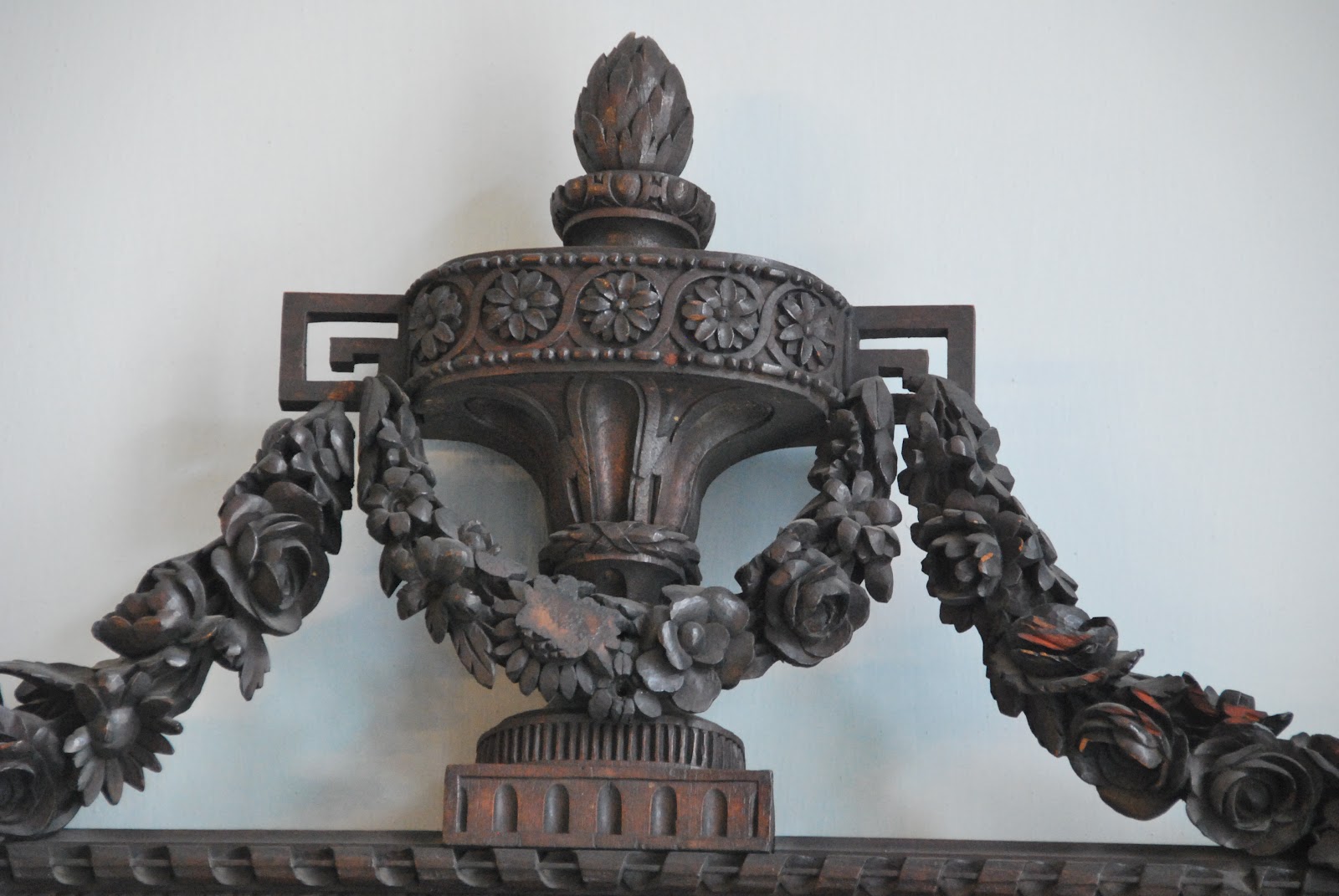
One world-famous feature of this building is the self-supporting oakwood spiral staircase extending over three floors and embellished with 21 small putto scenes depicting the various stages of clothmaking. In the old office rooms, two authentic cloth sample books comprising a total of 6,000 draft designs in various decors testify to the diversity and high quality of Scheibler's products, which were marketed throughout Europe in his day.

 |
| Carved staircase parts |

 |
| Rococo style Carved staircase |
The little town
on the River Rur with its narrow streets and half-timbered houses
blossomed in the 18th century. Here workers produced precious woollen
material which was exported to countries as far away as Turkey and
Russia.


During the peak years there were around 4,000 to 6,000 spinners and weavers in the Eifel and the region around Limburg, all working at home for Scheibler´s company. In this way they were able to eke out a little extra to supplement their meagre farming income.
When mechanical production began to take over at the start of the 19th century, it attracted waves of people into the town in search of paid work. But the poor road communications and the difficulty firms experienced in expanding their businesses in the narrow Rur valley resulted in the cloth industry gradually moving away from the area.

Now the Red House, more than anything else, stands as a reminded of the splendid period of textile production in Monschau.
Stiftung Scheibler-Museum
Rotes Haus Monschau
Laufenstr. 10
52156 Monschau
Phone: 02472-5071
Fax: 02472-9877604 Rotes-Haus@t-online.de
Opening hours: Good Friday - November 30 Tuesdays - Sunday Admission: every hour on the hour 10:00 and 11:00 a.m. 2:00, 3:00 and 4:00 p.m.
Admission charge: adults: € 3.00, students/children: free, school classes with guide per person: € 2,00
Information : Monschau Tourist information. Pictures of the interiors, Patrick Damiaens


During the peak years there were around 4,000 to 6,000 spinners and weavers in the Eifel and the region around Limburg, all working at home for Scheibler´s company. In this way they were able to eke out a little extra to supplement their meagre farming income.
 |
| Interior of The Red House, Monschau |
When mechanical production began to take over at the start of the 19th century, it attracted waves of people into the town in search of paid work. But the poor road communications and the difficulty firms experienced in expanding their businesses in the narrow Rur valley resulted in the cloth industry gradually moving away from the area.

Now the Red House, more than anything else, stands as a reminded of the splendid period of textile production in Monschau.
Stiftung Scheibler-Museum
Rotes Haus Monschau
Laufenstr. 10
52156 Monschau
Phone: 02472-5071
Fax: 02472-9877604 Rotes-Haus@t-online.de
Opening hours: Good Friday - November 30 Tuesdays - Sunday Admission: every hour on the hour 10:00 and 11:00 a.m. 2:00, 3:00 and 4:00 p.m.
Admission charge: adults: € 3.00, students/children: free, school classes with guide per person: € 2,00
Information : Monschau Tourist information. Pictures of the interiors, Patrick Damiaens
 |
| https://www.patrickdamiaens.info |