Welcome to my Blog
This is a place where the visitors are confronted with their search for a personal touch and where they have an opportunity to get acquainted with a skilled expert, who has turned durability and tradition into a personal passion.
I hope this will become a valued and rich source of inspiration and knowledge. Please Leave comments and enjoy your visit. Please note text and pictures on this blog are Copyright protected.

Wednesday, 23 October 2013

German magazine RESTAURO | Magazine covering Restoration Techniques | On the cover of “Restauro Preisliste”


On the cover of “Restauro Preisliste”
Price list for advertisement

Restauro, 
A German magazine covering restoration techniques.


For more than 115 years, the German magazine “Restauro” has been discussing and publishing the subject of restoration, preservation and maintenance of national and international heritage.
In the April 2013 edition, they published an extensive article about the restoration of a wooden chandelier from the Castle Lembeck in Westfalen, Germany. It was an assignment that we really enjoyed carrying out.
In this editorial piece, many pictures were shown concerning the various techniques used and difficulties encountered in carving the ornaments.


One of these pictures was used to grace the cover of the magazine “Preisliste 2014”.
The Restauro “Preisliste” or price list for advertisement is usually issued in autumn. It’s an additional little booklet of about 16 pages that is sent to subscribers and companies who are in the restoration business. 
I find it quite exceptional that I was considered for this year’s edition. 


Restoration Wooden Chandelier

https://www.patrickdamiaens.info

Monday, 7 October 2013

WOODCARVING CLASSES by Patrick Damiaens | A Course ornamental Woodcarving | Wood Carving Course - Classes in Belgium


 Wood Carving Course in Belgium
Are you looking to take a creative and technically advanced course?
Then maybe woodcarving – ornamental woodcarving might be something for you. This two-year training program, with possible specialization years, will give you a good insight into the various stages of carving (and working in relief on) ornaments and decorative panels in a wide variety of furniture styles.

For many years now, I’ve been teaching this course to passionate and interested people, who want to learn more about this complex subject. The course members start out with simple exercises, architectural designs, carving ...... and simple flower designs. 
The level of difficulty and complexity of the exercises is gradually increased and adapted to the individual capacities and wishes of the course member. The course member is introduced to various types of (raw) material, tools and equipment. You will learn all about different carving techniques and how to apply these. 

If you want to be notified of when a new course is planned, make sure to register on the waiting list.
These are a few pictures of the workshop and course members for the course 
“Ornamental Woodcarving”
of 2013-2014.


https://www.patrickdamiaens.info

Tuesday, 1 October 2013

CARVED WOODEN CHANDELIER | WOODCARVING 18th Century Style | Flemish Woodcarver J.F. Allaert | Designmuseum in Ghent, Belgium


A little-known masterpiece 
of 18th century Flemish Decorative Arts:

The Wooden chandelier by J.F. Allaert

A little while ago, I visited Ghent. This Flemish city has a wide range of historical buildings and places of interest. And a visit to the “Hotel de Coninck” was an absolute must. This museum houses a true masterpiece of 18th century Flemish Decorative arts.

In 1961, the city council of Ghent purchased a large wooden chandelier from an antique dealer in Brussels. This purchase was made at the same time negotiations were underway with a buyer who wanted this piece for a foreign collection. This chandelier was originally made to adorn the residence of the Knight F.J. de Coninck, presently housing the museum of decorative arts (known as the “Design Museum Gent”).
A brief description of the wooden chandelier is necessary to give a better idea of this masterpiece of Flemish industrial art.
The total height of the wooden chandelier is 1.80m and the diameter is 1.17m. The chandelier was carved from limewood.

Wooden Chandelier of J.F.Allaert
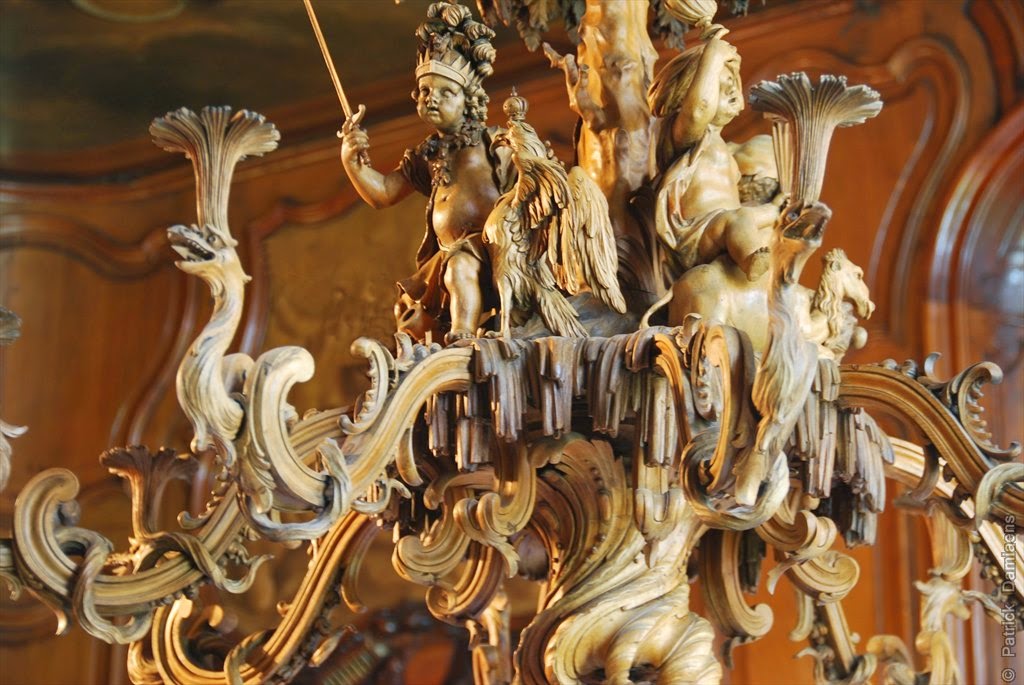
The principal decoration consists of four allegorical figures, placed at the foot of the tree of life. They symbolize the continents as seen through the eyes of people in the 18th century. These four symbolic figures are each about 0.30m tall and represent the four continents Europe, America, Asia and Africa.
The four continents
Europe is depicted as a child in an upright position, wearing a helmet made of feathers. Around its neck it’s wearing a necklace of the Order of the Golden Fleece. A slightly draped skirt covers the lower part of its body. Between its legs, there’s a canon. Its right hand is gripping a sword at the hilt. Its left hand is reaching for the neck of an eagle wearing an imperial crown.
A ship connects “Europe” to “America”. This ship has been carved in great detail, with small canons coming out of the side, a mast with a crow’s nest, an anchor, etc.

America is symbolized by a child dressed up as an Indian, with drawn bow and arrow. A quiver is leaning against its right leg, which is spread out over a crocodile.
Next to “America” we find “Africa”. The figure is wearing a hat in the shape of an elephant’s head with trunk. In its right hand, the child is holding a cornucopia, from which corncobs are protruding. It’s riding a lion with long manes and a half open mouth.
Between “Africa” and “Europe” a child symbolizing “Asia” is placed on a lying camel. It’s wearing a turban for a hat, and is holding a censer in its left hand and a beam of rays in its right. This depiction evokes images of the Middle East.


The palm tree rising up between these four allegories houses a nest on top of a fan-shaped crown. An eagle is snatching a cub from the nest, right from under a winged dragon, with fiery tongue. 
This bird, with its wings spread wide, is holding an iron ring in its right claw, from which the chandelier is hanging. Underneath the allegorical figures representing the four continents, eight similarly arched arms spring from the bottom of the chandelier. These end in a dragon, of which the head supports the candle holder.

It is generally assumed that this wooden chandelier was made particularly for this residence. Tradition tells us that the artist, J.F. Allaert, worked on decorating this mansion under the patronage of the Knight de Coninck for many years. Striking is the fact that the chandelier was signed and dated on the bottom, with the depiction of the four continents sitting on top. Near the arms of the chandelier, hidden by the first rocaille, it says “J.F. Allaert 1770”.

WOODCARVING  18th Century Style


J.F. Allaert
This Flemish Woodcarver was born in Ghent on 14 October 1703 and died on 2 January 1779, at the age of 76.

Designmuseum, Ghent
Website DESIGNMUSEUM GHENT 


https://www.patrickdamiaens.info


Monday, 23 September 2013

17th Century Style Wood carving | Acanthus leaf design carved in walnut | North German Baroque | Baroque Cabinet from DANZIG


17th Century Style Woodcarving

Woodcarving inspired by the style of the 17th century

 Acanthus leaf design carved in walnut

In this modest project I will introduce you to the method and technique for carving an acanthus leaf design for the 4 corners of the supporting or constructive part of a Danzig baroque cabinet. 


During the baroque a piece of furniture had to look luxuriant and rich in detail. With its robust yet elegant curls, the acanthus leaf is extremely suitable to radiate that luxuriant and rich feel, which makes it a design that is characteristic for this period.
Often they would use various types of wood as well as a variety of decorative techniques such as inlay, sculpting, gold leaf, etc. 
These techniques were used on one and the same piece of furniture to create that overwhelming sensation of richness. But the personality of a piece of furniture mainly came from the baroque woodcarving.

The symmetrical and crossed acanthus leaf design still tends to be the eye-catcher; a simple yet effective solution for limited space on the piece of furniture.
In its most basic form, a panel consists of a frame, a constructive part and the filling. An architectural frame is inlayed into the constructive part, to create a luxuriant effect and to add depth to the piece, which is another typical characteristic of the baroque period. 
The panel is completed with the inlay of a symmetrical composition executed in walnut, rosewood and coromandel wood.

The concerning panel is destined for a so called Danzig baroque cabinet or “Danziger”. 
A Danzig baroque cabinet is a typically regional 17th century piece of furniture, which (as you can tell by its name) originated from the region in and around the north German city of Danzig (currently the Polish Gdansk). 


17th Century Style Woodcarving , Acanthus leaf design


Baroque
The 17th century is an era that is marked by a great number of changes that took place throughout Europe: exploratory expeditions, rediscovery of Greek and Roman art and science. 
The architecture of these two peoples came back into fashion, giving rise to a new style: baroque. Baroque stretches from the middle of the 17th century to the first half of the 18th century. Baroque wasn’t just limited to architecture alone. 
Quite the contrary! Sculpture, furniture, ornamentation and music were all influenced as well.

Early baroque found its origin in Italy, more specifically in Rome, and slowly started to fan out to northern Europe. It’s interesting to see that the style developed differently in different areas, according to the temperament of the inhabitants of a certain region, and due to the influences of artists and tradesmen.

These differences in style are specifically noticeable in the ornamentation.
A distinction is made between early, high and late baroque. Late baroque is also known as rococo. 
Early baroque still inclined towards the renaissance, whereas late baroque overindulged in luxuriance, with much pomp and circumstance.
Over time many rulers discovered the effects of the dramatic baroque style; we see it used by the Vatican during the Counter Reformation. By putting the emphasis on splendor and magnificence in the architectural style of churches, the Roman Catholic Church was trying to impress people and lure them back to church.  

This, however, caused a breach within the Roman Catholic Church: Protestantism was born, leading to austerity in protestant countries.
One of the developments of the baroque period is that pieces of furniture display less and less architectural characteristics. They no longer resemble miniaturized constructions; there’s a tendency to use more exotic types of wood, rather than local types of wood; and other materials are applied, such as brass, tin and tortoise.
The use of exotic wood (ebony, palisander, acajou) coincides with the expeditions made to East and West India.

The fact that people at this time are more self-assured and start acting as individuals, who tend to make their own choices (notably among artists and tradesmen), leads to a decline in the use of traditional materials and to the creation of completely new furniture. 
The upper class, that is growing ever richer, wants to flaunt its wealth. The result of this is that we now have an amazing collection of furniture from this period in our patrimony.

The carving of a stylized
acanthus leaf design in walnut


Acanthus leaf design carved in walnut

Baroque Cabinet from DANZIG

https://www.patrickdamiaens.info
https://www.facebook.com/patrick.damiaens.ornamental.woodcarver