Welcome to my Blog
This is a place where the visitors are confronted with their search for a personal touch and where they have an opportunity to get acquainted with a skilled expert, who has turned durability and tradition into a personal passion.
I hope this will become a valued and rich source of inspiration and knowledge. Please Leave comments and enjoy your visit. Please note text and pictures on this blog are Copyright protected.

Showing posts with label 'Palace in France'. Show all posts

Tuesday, 1 October 2019

Royal monogram of Louis XIV | Decoration style Versailles | Monogram as a symbol in the ornamentation | The Sun King

Royal monogram of Louis XIV | Decoration style Versailles


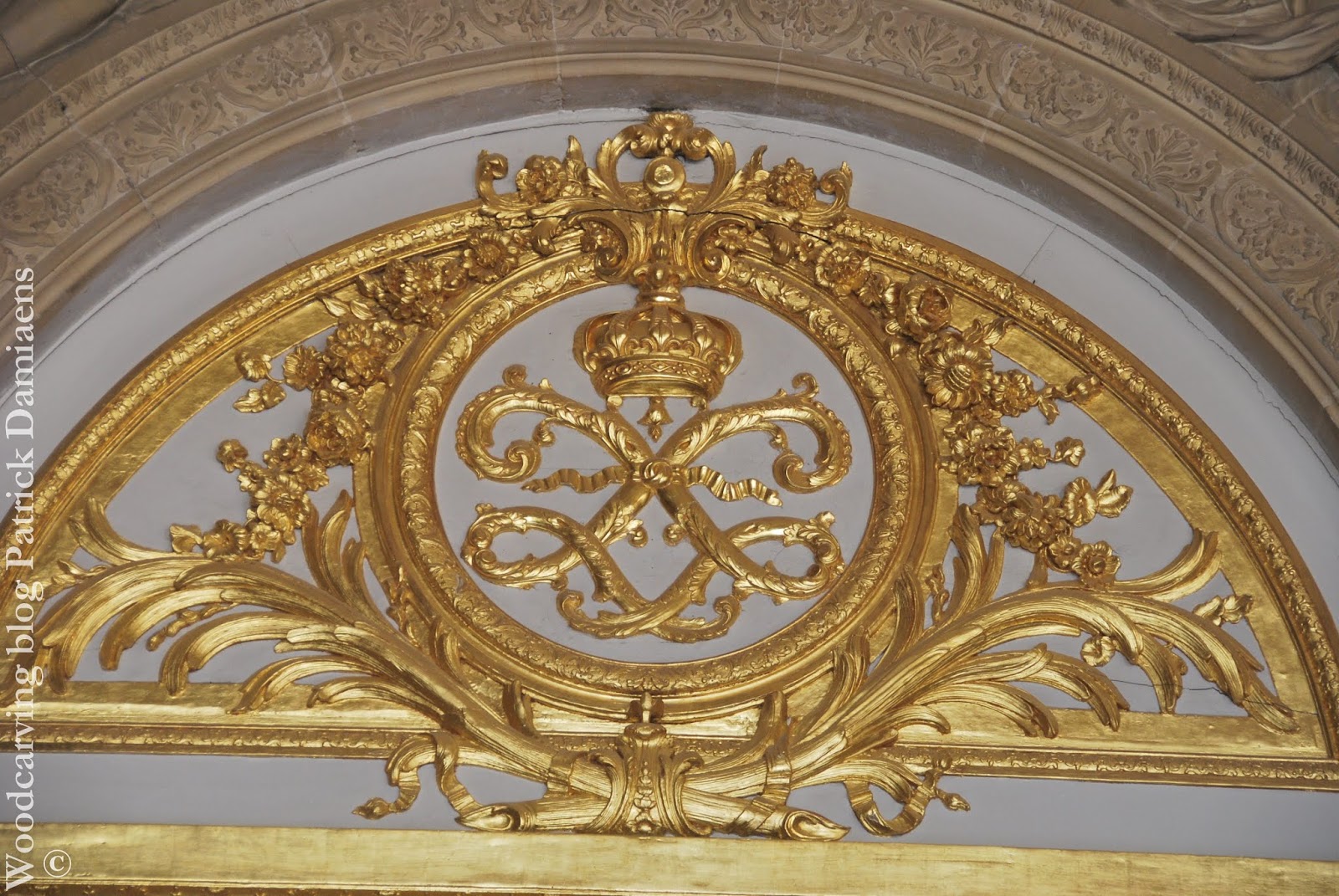
The Royal monogram of King Louis XIV, the L in mirror writing interwoven.
A personal monogram of the Sun King
 Louis XIV, King of France.

A blog entry from : https://www.patrickdamiaens.info

When you enter the French royal castles, you are confronted with it everywhere. The visitor can't miss it, and that's what was intended: a monogram shows you that you are in a royal residence.

The monogram as an ornament

A monogram is a figure that consists of two or more letters and/or other graphic signs to create a kind of logo or recognizable symbol. Where a logo always looks the same, a monogram can always appear in a different form as long as the letters or signs remain recognisable.

The often crowned monograms of monarchs are widely used. Their monograms were depicted on stamps, coins, linen, utensils and knights' orders. Known are the monograms of the English kings who adorn many lampposts in London and the post boxes throughout Great Britain.
In the case of kings it is customary to include an R for REX or REGINA for queens (Latin: king or queen) in the monogram.
The I in a royal monogram stands for Imperator of Imperatrix (Latin: emperor or empress), For a noble monogram the D for Dux (Latin: duke), and the C for Comes (Latin: count).


Versailles

Everywhere the decor of Versailles combines the royal emblems: the double L, the royal crown, the sceptre and the hand of justice.
This monogram can be found on the panelling and doors of the king's apartments as well as on gates and forged fencing.
The monogram consists of the first letter of a name, doubled and interwoven in a single character, as here the letter L of Louis (Louis). It is assumed that the monogram is a royal signature.


I haven't published an English-language blog entries in a while. It just costs me too much money to have my dutch blogs translated into english. This free info blog is pure fun for me but if it costs me a lot of money the enthusiasm from my part is far away.
But in the meantime I have found a free site online that does pretty good translations. So here is my first translation of this blog about The Royal monogram of Louis XIV. Hopefully the traduction will be easy to read.

Translated with www.DeepL.com/Translator


Here are some examples of the double L in the decoration. 
The pictures are mainly taken 
in the castles of Versailles and Fontainebleau.

Versailles, Salon of War |
Monogram of the Sun King

Monogram of the Sun King |
Louis XIV, The Sun King

Versailles, Vestibule of the chapel on the 1st floor |
Monogram of the Sun King

Carved paneling in the Palace of Versailles |
Gilded ornaments | Versailles ornamentation

In the gardens of Versailles |
Monogram Louis XIV carved on a door, a supraporte ornament

Versailles | Monogram Louis XIV |
Monogram of the Sun King

A carved overdoor ornament | Castle of Versailles
Monogram of Louis XIV

Versailles | The symbol of Louis XIV immortalized in a sculpture

Palace of Versailles |
Monogram of the Sun King

Fontainebleau Castle |
Royal monogram of Louis XIV in palm leaf form

Part of the balustrade in the Royal Chapel
| Fontainebleau Castle | Monogram of the Sun King

Forged fence with the symbol of Louis XIV |
Monogram of the Sun King
Le Grand Trianon | Monogram as a symbol in the ornamentation |
The Sun King


The sun as an emblem.

Another typical ornament of Louis the XIV that is often associated in ornamental compositions and in the decoration of his castles is the emblem of the sun. The God Apollo is surrounded by sunbeams. The sun was associated with Apollo, god of peace and art, and the sun was also the heavenly body that gave life to all things, everything arranged as it rose and set.

Like Apollo, the warrior-king Louis XIV brought peace, was a patron of the arts and spent his generosity. The regularity of his working habits and his ritual increases and retirements (scaffolding and couchee) were another point of solar comparison.

In Versailles, decorations combine images and attributes of Apollo (laurel, winch, tripod) with the portraits and emblems of the king (the solar motif, the sceptre and the hand of justice that embellish this door).


The young Louis XIV loved to dance and play in different court performances. Once he had to play the role of the sun in the Ballet de la Nuit. After this performance, he decided to choose the sun as his symbol. To this day he is known as the Sun King (Le Roi Soleil).

The fence of the Castle of Versailles |
Sunbeams, the God Apollo and the monogram of Louis XIV

The sun as an emblem | The Sun King

Marble vase in the gardens of the Castle of the Sun King |
Castle of Versailles


https://www.patrickdamiaens.info

More info on my FB Page (LINK)


Sunday, 2 October 2016

A visit to the PALACE OF COMPIÈGNE | The Castle of PIERREFONDS | An excursion with some of my students Ornamental Woodcarving

 A visit to the PALACE OF COMPIÈGNE

A visit to the Castle (Palace) of Compiègne 
and the castle of Pierrefonds.
Ornamental woodcarving student’s visit.

For many years now, in company with the students in training for ornamental woodcarving, we make an annual excursion. Versailles Palace is one of these places and they are looking forward to visit it, but this year I have chosen a wonderful destination in the north of France.
In mid-July (2015), a bit late as normally, it seemed a good idea to visit the castle (palace) of Compiègne and the castle of Pierrefonds. Compiegne and Pierrefonds are to completely different historic buildings, but they had in common that they had same owner/occupant.

A visit to Compiègne Castle / view from the garden.

The Palace of Compiègne.  The rooms on the first floor
From Maaseik, in Belgium(Where I live), direction Compiègne, it takes about 3 ½ hrs driving and is well doable; Pierrefonds is just 15 minutes away from Compiegne. Compiegne is known for being the start point of the cycling race Paris-Roubaix. And here was the place where the Germans surrender during the First World War, in a train car just outside Compiegne.
Compiègne Castle is a castle which is still undiscovered by mass tourism, situated in a beautiful historic center. Beautiful sandstone buildings and homes, you notice that there is an atmosphere “that tells you that once this must have been an important place to be”, the same image you get in the old town of Versailles.
The choice of a visit to Compiègne was mainly because of the unique, beautiful preserved, historic interiors dating back to the late 18th century to mid-19th century. Period rooms crammed with furniture in Empire style (around 1810) and Napoleon III style (around 1860). It was pleasant to walk around, affordable ticket (7, 5 euro) and for 2 more euros you can have the audio guide in order to have more information.

Empress’ bedroom / Chateau de Compiègne.


Chateau Compiègne was one of the residences of Emperor Napoleon Bonaparte (Empire style) and 50 years later, of Emperor Napoleon III (Napoleon III style or 2nd empire). Compiegne has unique, beautiful preserved, historic interiors. We had a bit of luck, there was an exhibition running, an exhibition over the Empire decorative arts between 1800 -1815. For me, personally, this was a comprehensive retrospective. And all this beauty was included in the entry ticket, really worthy.
I will definitely put more attention to the Empire style and to this castle in my next blog entry.


One of the many rooms of the exhibition. | Palace of Compiègne


Chateau Pierrefonds 
_________________________

The Castle of PIERREFONDS


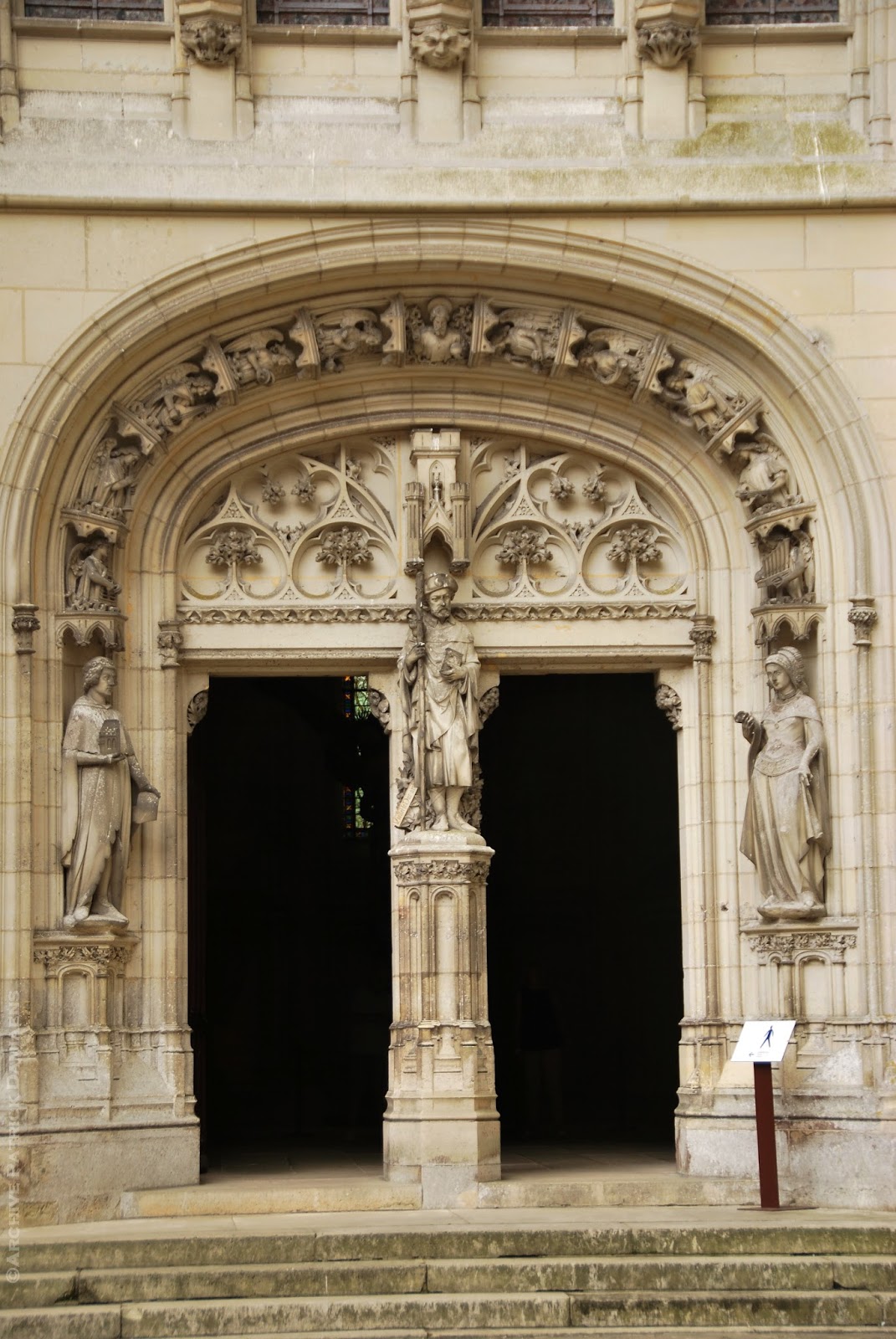
Chateau Pierrefonds was originally a medieval fortress, which fell into disrepair and was restored and reconstructed around 1860 by Napoleon II orders. Napoleon III made of it a place of residence.
But –again- no crowds. Later that day I even had the impression that there were more visitors around Pierrefonds Castle than in Chateau Compiegne. This is probably due to the charisma and romantic image of a “fortress”, and has a great appeal to the younger tourists, which usually do not have such interest in dusty rooms full of history and furniture.
It becomes apparent that the restoration made by the architect Viollet-le-Duc was good, following the style of other castles from the same period. The interior of the castle offers an overview of historic rooms in neo-style, from neo-Gothic to neo-renaissance.


We found many woodcarvings, but the quality and originality are exceptional. There is an abundance of ornamentation in stone and stucco of remarkable craftsmanship, you need to stand still and absorb the beauty of the work. Even stone ornaments can be the source of inspiration for a woodcarver. The entry ticket to this castle, individual visitor, is 7, 50 euros. If you visit both places, you can ask for combination ticket.

 An excursion with some of my students Ornamental Woodcarving

 In the garden of Chateau Compiegne.

Translation by Lis Alvarado

Here, a brief photo description:


Chateau Compiègne
_____________________
________________

A visit to the PALACE OF COMPIÈGNE


Emperor’s bedroom | The Palace of Compiègne


Room with flowers / Chateau de Compiègne.

Blue Room, Compiègne.

Empress dining room / Chateau de Compiègne


Compiègne Castle / Imperial dining room, detail.


Chateau de Pierrefonds
______________________

The Castle of PIERREFONDS


The Castle of PIERREFONDS | Napoleon III bedroom


Carving details, Reception room.


Ornament in stone / ceiling spiral staircase.


https://www.patrickdamiaens.info

Ornamental woodcarver FB PAGE