Welcome to my Blog
This is a place where the visitors are confronted with their search for a personal touch and where they have an opportunity to get acquainted with a skilled expert, who has turned durability and tradition into a personal passion.
I hope this will become a valued and rich source of inspiration and knowledge. Please Leave comments and enjoy your visit. Please note text and pictures on this blog are Copyright protected.

Showing posts with label 'Baroque and Rococo period style Interiors'. Show all posts

Tuesday, 26 January 2021

A wooden carved Rococo mirror frame | Large wooden rococo style mirror | Carved and Gilded mirror over a chimney | Architectural woodcarving

A wooden carved Rococo mirror frame |  Large wooden rococo style mirror | Carved and Gilded mirror over a chimney | Architectural woodcarving
Carving a Rococo mirror frame |
 Patrick Damiaens, ornamental woodcarver

Carving a Rococo style mirror in wood

Wooden mirror for above a mantelpiece 
Gilded Rococo mirror frame

A blogentry from this site:

We always start with a design, my creation of a Rococo mirror frame was based on an example made in polyester. This polyester copy had been hanging in my client's living room for 25 years. 
If you think long term, polyester is not a good investment, it hasn't had a long life, small and medium sized parts and pieces broke off from the mirror for quite some time now, the whole Rococo mirror was actually falling apart, and becoming sprinkly. 
So it was time to replace it and the only option was for the customer to make an (improved) copy of the polyester model.

It is always nice to be able to make a nice design, this Rococo mirror is meant as decoration for a marble mantelpiece, sometimes you can see this kind of mirrors in a wooden trumeau, this one is about 2 meters high and 120 wide and intended for a house in the Netherlands. 
Rococo is one of the more difficult styles to reproduce. Horizontal lines are almost non-existent, they are replaced by delicate curves, long drawn or pulled acanthusleaf motifs and many rocailles motifs merge into one another. Asymmetry is the strong point of this style. 
The effect is capricious, marvelous, captivating and enchanting. It is a style that appeals more to the senses, less to the intellect and emphasizes beauty over content.

Carving a Rococo frame | A wooden carved Rococo mirror frame |  Large wooden rococo style mirror | Carved and Gilded mirror over a chimney | Architectural woodcarving | Rococo frames custom made

Carving a Rococo frame | A wooden carved Rococo mirror frame |  Large wooden rococo style mirror | Carved and Gilded mirror over a chimney | Architectural woodcarving | Rococo frames custom made


Placing a drawing on the wood 


The preparation of the lime wood construction of the mirror, the sawing and the various operations with the router has taken a lot of time. Accuracy is important in every phase at this stage and that starts with transferring the drawing of the Rococo mirror to lime paper, by means of carbonless paper or hand film, the design of the Rococo mirror is transferred to the wood. 
Remember this drawing is very important and you should definitely check it carefully (on lime paper and on the wood) to make sure that all the lines of the design are present. 
Even a not unimportant..., a bad design or drawing can only lead to a bad end result. All stages in this phase of the creation are linked to each other, if you forget something or if you prepare something badly, this will have consequences at a later stage. 
The four separate parts are glued to an MDF board, between the wood of the mirror and the MDF board is a newspaper or ordinary paper glued, this will ensure that after finishing the cutting work the part of the mirror is easily detached from the MDF board.


Practical mounting


The carving of the ornaments happens in this case with the drawing and the polyester example on the workbench. With an altimeter we take crucial measurements on the original and transfer these reference heights to the lime wood. 
The large frame is cut first and then serves as a reference for and Rococo design of the ornaments, these ornaments have specific names, such as rocaille, acanthus leaf motif, agraphe, etc.... Each stage in the carving of an ornament is important but we start with the rough shaping of the whole and gradually refine it, until we are satisfied with design and finishing. 
When the visible front of each part, in this case four pieces, is ready we turn the piece around, put it in a blanket and start cutting the back, the excess wood behind the ornament is removed and the Rococo ornament begins to come loose visually, you look sideways no longer against a mass of wood, and all attention goes to the ornament itself. What remains are the four transitions of the parts, making sure that mouldings and ornaments merge smoothly into one another.

Carving a Rococo frame | A wooden carved Rococo mirror frame |  Large wooden rococo style mirror | Carved and Gilded mirror over a chimney | Architectural woodcarving | Rococo frames custom made


This Rococo mirror frame will still be provided with gold leaf, but that's another specialisation that will be done by another craftsman.

Rococo


The rococo style is a European style period that reached its peak between 1730 and 1760. The name rococo is derived from the French word rocaille: an asymmetrical shell motif that was widely used in the mid-18th century on furniture, doors, panelling, etc.. 
The word rocaille goes back to the French words roc (rock) and coquilles (shells) and indicates that it is mainly a decorative style.
Rococo originated in France as a reaction to the severe classicist baroque of around 1700. 
The subsequent Rococo style is characterised by grace, elegance, charm, wit and playful eroticism. The style remained popular for over seventy years in the eighteenth century. After that, the style of neoclassicism gradually made its appearance and the rococo style disappeared.


As many styles have received their names in art history, the name rococo was initially intended to be mocking. The word refers to decorative shell shapes from the Baroque period. 
Despite the many commissions, the Rococo artists were severely criticised. Opponents felt that their works of art were not serious enough in terms of content. Moreover, it was thought to be too much in the service of the decadent upper class. Therefore, the Rococo was mainly regarded as a decorative style. 


WIKI 

Rococo, less commonly  Late Baroque, is an exceptionally ornamental and theatrical style of architecture, art and decoration which combines asymmetry, scrolling curves, gilding, white and pastel colors, sculpted molding, and trompe l'oeil frescoes to create surprise and the illusion of motion and drama. It first appeared in France and Italy in the 1730s and spread to Central Europe in the 1750s and 1760s. It is often described as the final expression of the Baroque movement.

The Rococo style began in France in the first part of the 18th century in the reign of Louis XV as a reaction against the more formal and geometric Style Louis XIV. It was known as the style rocaille, or rocaille style. It soon spread to other parts of Europe, particularly northern Italy, Bavaria, Austria, other parts of Germany, and Russia. It also came to influence the other arts, particularly sculpture, furniture, silverware and glassware, painting, music, and theatre.


Carving a Rococo frame | A wooden carved Rococo mirror frame |  Large wooden rococo style mirror | Carved and Gilded mirror over a chimney | Architectural woodcarving | Rococo frames custom made


Carving a Rococo frame | A wooden carved Rococo mirror frame |  Large wooden rococo style mirror | Carved and Gilded mirror over a chimney | Architectural woodcarving | Rococo frames custom made

Carving a Rococo frame | A wooden carved Rococo mirror frame |  Large wooden rococo style mirror | Carved and Gilded mirror over a chimney | Architectural woodcarving | Rococo frames custom made

Carving a Rococo frame | A wooden carved Rococo mirror frame |  Large wooden rococo style mirror | Carved and Gilded mirror over a chimney | Architectural woodcarving | Rococo frames custom made

Carving a Rococo frame | A wooden carved Rococo mirror frame |  Large wooden rococo style mirror | Carved and Gilded mirror over a chimney | Architectural woodcarving | Rococo frames custom made

Carving a Rococo frame | A wooden carved Rococo mirror frame |  Large wooden rococo style mirror | Carved and Gilded mirror over a chimney | Architectural woodcarving | Rococo frames custom made

Carving a rococo frame | A wooden carved Rococo mirror frame |  Large wooden rococo style mirror | Carved and Gilded mirror over a chimney | Architectural woodcarving

Rococo wooden ornaments | A wooden carved Rococo mirror frame |  Large wooden rococo style mirror | Carved and Gilded mirror over a chimney | Architectural woodcarving

Patrick Damiaens | A wooden carved Rococo mirror frame |  Large wooden rococo style mirror | Carved and Gilded mirror over a chimney | Architectural woodcarving

A wooden carved Rococo mirror frame |  Large wooden rococo style mirror | Carved and Gilded mirror over a chimney | Architectural woodcarving

A wooden carved Rococo mirror frame |  Large wooden rococo style mirror | Carved and Gilded mirror over a chimney | Architectural woodcarving

A wooden carved Rococo mirror frame |  Large wooden rococo style mirror | Carved and Gilded mirror over a chimney | Architectural woodcarving

patrick damiaens ornamental woodcarver
https://www.patrickdamiaens.info


Tuesday, 15 September 2015

The Palace of Bruchsal | German Palace | A castle in Baden-Württemberg | Interior in Baroque and Rococo periods.


The Palace - Castle of Bruchsal

Bruchsal Palace  
A Castle-Palace in Baden-Württemberg 
 Interior in Baroque and Rococo periods.
_______________________
___________________ 

In this blog article we will visit the Bruchsal Castle - Palace in in Baden-Württemberg, a special big castle with an interior decoration in Baroque and Rococo periods.  

The city of Bruchsal is located in the west of Germany, in the area of in Baden-Württemberg; you will practically cross it when you're on your holiday’s trip, driving out of Belgium,the Netherlands or Luxemburg on your way to southern Germany, Austria and Italy, Bruchsal is located at the E52 near Karlsruhe.
It is really worthwhile to stop there for a moment; the city has much to offer in terms of history and the Castle of Bruchsal with its baroque interior worth a visit.
The castle houses the German music box museum. A short break during your busy highway-trip, where you can enjoy culture and have something to eat in the Castle restaurant. Highly recommended.

The Castle - Palace of Bruchsal


The Palace of Bruchsal | The entrance

Bruchsal Castle.

Bruchsal Castle was founded in 1720 as a residence for the prince-bishops of Speyer. Four of them have Bruchsal Castle built during the 18th Century, inhabited and the final was 80 years at the center of their absolute dominion and power.
Under the supervision of Cardinal Damian Hugo von Schönborn a complex of 50 buildings were built; the main building with two wings from Loss Burger sandstone is the absolute eye-catcher.

Colorful, fur and festive, that's the first impression you get when entering the 'cour d'honneur, the courtyard wedged between the three main buildings of the castle complex. The buildings are richly decorated, painted and fitted with gilded stucco. The two roof ends of the main building are very beautifully made and decorated with impressive dragons forged in metal.


Oval staircase, Balthasar Neumann

The famous Baroque architect Balthasar Neumann (1687-1753), was one of the architects who gave shape to the castle, along with many craftsmen and artists in stucco specialist who previously had worked with him in the construction of the 'Residenz "in Würzburg.
Around 1728 Balthazar Neumann designed his famous oval staircase in Baroque style for his client. A staircase unique in its kind. Two oval staircases run up on each side facing each other. 
The stairway ends impressively under a huge painted dome.

The Palace of Bruchsal |  The Prince Hall


Interior in Baroque and Rococo periods.


In the middle room with adjacent two ballrooms, the Prince Hall and the Marble Hall. 
Upon completion of the work in 1750 Schönborn's successor, Cardinal Franz Christoph von Hutten, gave the rooms a German Rococo style decoration. This work was completed in 1760.

The wall and ceiling paintings obviously have a Christian theme and all this combined with the gilded stucco and scagliola has become a very tasteful work.

 Interior in Baroque and Rococo periods.

The Palace of Bruchsal | Gilded Rococo Ornaments

The Marble Hall, Palace of Bruchsal
In the aftermath of the Second World War the castle interior was almost completely destroyed. Fortunately, the structural part of the stairwell survived the bombing of March 1, 1945. Fortunately, archives and a detailed archived photo preserved from the 19th and 20th centuries were used for the reconstruction of the castle, as original as possible. 
After visiting the palace’s corps de logis (main part of the building), we recommend you pay a visit to the German Museum of Mechanical Musical Instruments and the Bruchsal City Museum.

Translation Lis Alvardo


Bruchsal Castle Opening hours:

Tue to Sun. 10:00 to 17:00

Entrance fee: adults 5 Euro


Website:
http://www.schloss-bruchsal.de


https://www.patrickdamiaens.info

link FB PAGE

Tuesday, 1 October 2013

CARVED WOODEN CHANDELIER | WOODCARVING 18th Century Style | Flemish Woodcarver J.F. Allaert | Designmuseum in Ghent, Belgium


A little-known masterpiece 
of 18th century Flemish Decorative Arts:

The Wooden chandelier by J.F. Allaert

A little while ago, I visited Ghent. This Flemish city has a wide range of historical buildings and places of interest. And a visit to the “Hotel de Coninck” was an absolute must. This museum houses a true masterpiece of 18th century Flemish Decorative arts.

In 1961, the city council of Ghent purchased a large wooden chandelier from an antique dealer in Brussels. This purchase was made at the same time negotiations were underway with a buyer who wanted this piece for a foreign collection. This chandelier was originally made to adorn the residence of the Knight F.J. de Coninck, presently housing the museum of decorative arts (known as the “Design Museum Gent”).
A brief description of the wooden chandelier is necessary to give a better idea of this masterpiece of Flemish industrial art.
The total height of the wooden chandelier is 1.80m and the diameter is 1.17m. The chandelier was carved from limewood.

Wooden Chandelier of J.F.Allaert
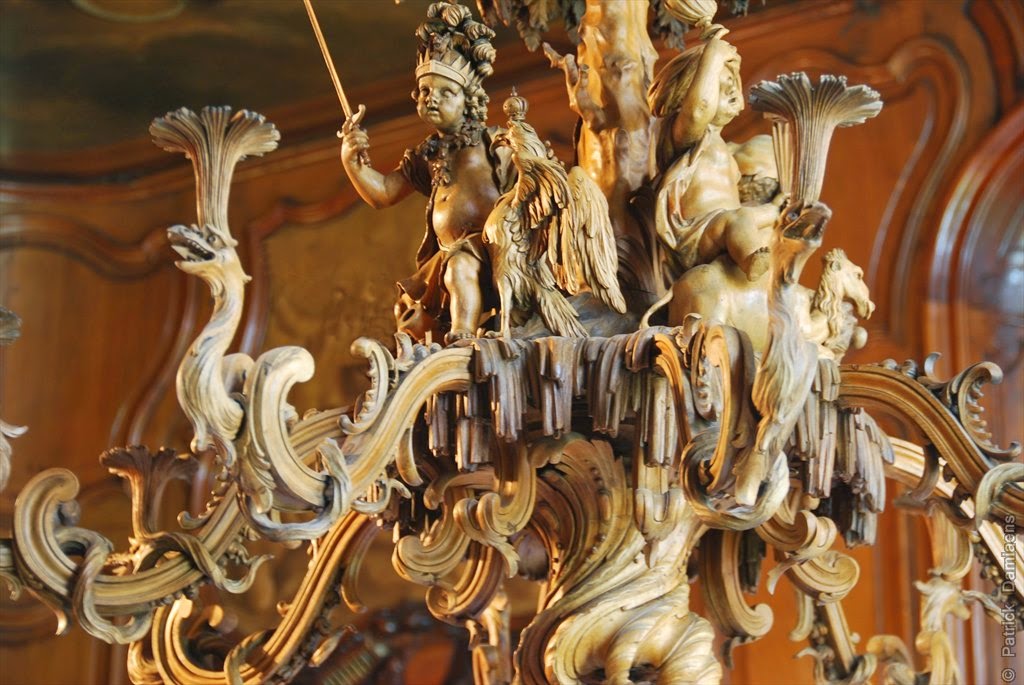
The principal decoration consists of four allegorical figures, placed at the foot of the tree of life. They symbolize the continents as seen through the eyes of people in the 18th century. These four symbolic figures are each about 0.30m tall and represent the four continents Europe, America, Asia and Africa.
The four continents
Europe is depicted as a child in an upright position, wearing a helmet made of feathers. Around its neck it’s wearing a necklace of the Order of the Golden Fleece. A slightly draped skirt covers the lower part of its body. Between its legs, there’s a canon. Its right hand is gripping a sword at the hilt. Its left hand is reaching for the neck of an eagle wearing an imperial crown.
A ship connects “Europe” to “America”. This ship has been carved in great detail, with small canons coming out of the side, a mast with a crow’s nest, an anchor, etc.

America is symbolized by a child dressed up as an Indian, with drawn bow and arrow. A quiver is leaning against its right leg, which is spread out over a crocodile.
Next to “America” we find “Africa”. The figure is wearing a hat in the shape of an elephant’s head with trunk. In its right hand, the child is holding a cornucopia, from which corncobs are protruding. It’s riding a lion with long manes and a half open mouth.
Between “Africa” and “Europe” a child symbolizing “Asia” is placed on a lying camel. It’s wearing a turban for a hat, and is holding a censer in its left hand and a beam of rays in its right. This depiction evokes images of the Middle East.


The palm tree rising up between these four allegories houses a nest on top of a fan-shaped crown. An eagle is snatching a cub from the nest, right from under a winged dragon, with fiery tongue. 
This bird, with its wings spread wide, is holding an iron ring in its right claw, from which the chandelier is hanging. Underneath the allegorical figures representing the four continents, eight similarly arched arms spring from the bottom of the chandelier. These end in a dragon, of which the head supports the candle holder.

It is generally assumed that this wooden chandelier was made particularly for this residence. Tradition tells us that the artist, J.F. Allaert, worked on decorating this mansion under the patronage of the Knight de Coninck for many years. Striking is the fact that the chandelier was signed and dated on the bottom, with the depiction of the four continents sitting on top. Near the arms of the chandelier, hidden by the first rocaille, it says “J.F. Allaert 1770”.

WOODCARVING  18th Century Style


J.F. Allaert
This Flemish Woodcarver was born in Ghent on 14 October 1703 and died on 2 January 1779, at the age of 76.

Designmuseum, Ghent
Website DESIGNMUSEUM GHENT 


https://www.patrickdamiaens.info