Welcome to my Blog
This is a place where the visitors are confronted with their search for a personal touch and where they have an opportunity to get acquainted with a skilled expert, who has turned durability and tradition into a personal passion.
I hope this will become a valued and rich source of inspiration and knowledge. Please Leave comments and enjoy your visit. Please note text and pictures on this blog are Copyright protected.

Showing posts with label 'Decorative symbolism'. Show all posts

Tuesday, 1 October 2019

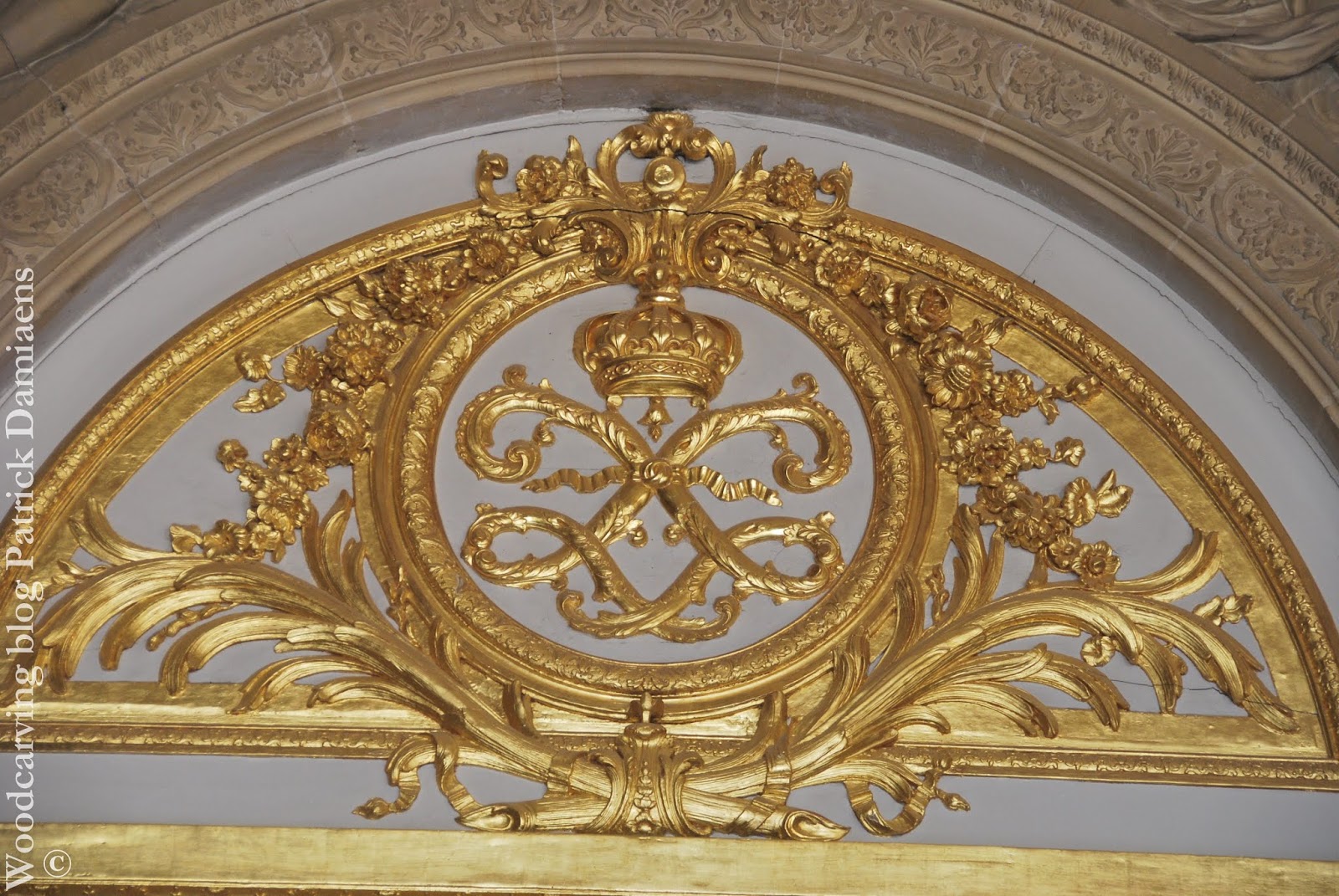
Royal monogram of Louis XIV | Decoration style Versailles | Monogram as a symbol in the ornamentation | The Sun King

Royal monogram of Louis XIV | Decoration style Versailles


The Royal monogram of King Louis XIV, the L in mirror writing interwoven.
A personal monogram of the Sun King
 Louis XIV, King of France.

A blog entry from : https://www.patrickdamiaens.info

When you enter the French royal castles, you are confronted with it everywhere. The visitor can't miss it, and that's what was intended: a monogram shows you that you are in a royal residence.

The monogram as an ornament

A monogram is a figure that consists of two or more letters and/or other graphic signs to create a kind of logo or recognizable symbol. Where a logo always looks the same, a monogram can always appear in a different form as long as the letters or signs remain recognisable.

The often crowned monograms of monarchs are widely used. Their monograms were depicted on stamps, coins, linen, utensils and knights' orders. Known are the monograms of the English kings who adorn many lampposts in London and the post boxes throughout Great Britain.
In the case of kings it is customary to include an R for REX or REGINA for queens (Latin: king or queen) in the monogram.
The I in a royal monogram stands for Imperator of Imperatrix (Latin: emperor or empress), For a noble monogram the D for Dux (Latin: duke), and the C for Comes (Latin: count).


Versailles

Everywhere the decor of Versailles combines the royal emblems: the double L, the royal crown, the sceptre and the hand of justice.
This monogram can be found on the panelling and doors of the king's apartments as well as on gates and forged fencing.
The monogram consists of the first letter of a name, doubled and interwoven in a single character, as here the letter L of Louis (Louis). It is assumed that the monogram is a royal signature.


I haven't published an English-language blog entries in a while. It just costs me too much money to have my dutch blogs translated into english. This free info blog is pure fun for me but if it costs me a lot of money the enthusiasm from my part is far away.
But in the meantime I have found a free site online that does pretty good translations. So here is my first translation of this blog about The Royal monogram of Louis XIV. Hopefully the traduction will be easy to read.

Translated with www.DeepL.com/Translator


Here are some examples of the double L in the decoration. 
The pictures are mainly taken 
in the castles of Versailles and Fontainebleau.

Versailles, Salon of War |
Monogram of the Sun King

Monogram of the Sun King |
Louis XIV, The Sun King

Versailles, Vestibule of the chapel on the 1st floor |
Monogram of the Sun King

Carved paneling in the Palace of Versailles |
Gilded ornaments | Versailles ornamentation

In the gardens of Versailles |
Monogram Louis XIV carved on a door, a supraporte ornament

Versailles | Monogram Louis XIV |
Monogram of the Sun King

A carved overdoor ornament | Castle of Versailles
Monogram of Louis XIV

Versailles | The symbol of Louis XIV immortalized in a sculpture

Palace of Versailles |
Monogram of the Sun King

Fontainebleau Castle |
Royal monogram of Louis XIV in palm leaf form

Part of the balustrade in the Royal Chapel
| Fontainebleau Castle | Monogram of the Sun King

Forged fence with the symbol of Louis XIV |
Monogram of the Sun King
Le Grand Trianon | Monogram as a symbol in the ornamentation |
The Sun King


The sun as an emblem.

Another typical ornament of Louis the XIV that is often associated in ornamental compositions and in the decoration of his castles is the emblem of the sun. The God Apollo is surrounded by sunbeams. The sun was associated with Apollo, god of peace and art, and the sun was also the heavenly body that gave life to all things, everything arranged as it rose and set.

Like Apollo, the warrior-king Louis XIV brought peace, was a patron of the arts and spent his generosity. The regularity of his working habits and his ritual increases and retirements (scaffolding and couchee) were another point of solar comparison.

In Versailles, decorations combine images and attributes of Apollo (laurel, winch, tripod) with the portraits and emblems of the king (the solar motif, the sceptre and the hand of justice that embellish this door).


The young Louis XIV loved to dance and play in different court performances. Once he had to play the role of the sun in the Ballet de la Nuit. After this performance, he decided to choose the sun as his symbol. To this day he is known as the Sun King (Le Roi Soleil).

The fence of the Castle of Versailles |
Sunbeams, the God Apollo and the monogram of Louis XIV

The sun as an emblem | The Sun King

Marble vase in the gardens of the Castle of the Sun King |
Castle of Versailles


https://www.patrickdamiaens.info

More info on my FB Page (LINK)


Sunday, 11 February 2018

Fasces symbol as an ornament | Lictors Bundle | Decorative symbolism | FASCES made of wood, stone and metal | FASCES

The fasces symbol as an ornament |  Lictors Bundle 

Since I started with my studies about ornamental wood carving, I have come across a symbol on the street, in a museum or on a furniture; a symbol to which I did not pay too much attention at the beginning. 
Than since Marc van de Cruys, -editor of the magazine Heraldicum Disputationes*- has devoted an article about it, I have immersed myself in this symbol. What I discovered about the symbol turned out to be so interesting that I want to highlight it in this blog.

*Heraldicum Disputationes is a Belgian magazine specialized in the theme of heraldry. The magazine appears four times per year and an annual subscription cost only 20 euros.

The fasces symbol 

The symbol where this blog is all about is the ‘fasces’ or ‘Lictors Bundle’.
The fasces (latin, singular ‘fascis’, plural ‘fasces’) is a rod bundle, a bundle of sticks that encloses an ax and that is tied together with a belt. If you do not know the right meaning of this symbol, it looks like any other decorative ornament. But on the contrary, this symbol has a unique meaning.

The rods, usually birch but sometimes elm sticks, were a symbol of the ‘power to punish’. The ax symbolized the ‘power over life and death’ and the red leather belts means the ‘power to arrest’. The fasces thus symbolize the authority of the higher magistrates and dates to the time of the ancient Romans.


Whenever our Roman authorities made an official tour, they were preceded by the fasces as signs of authority, carried by officials (the Lictores) . That is why the fasces are also known as lictors bundles.

The number of fasces carried by a magistrate corresponded to his position. For example, a Roman consul was escorted by 12 lictors; in comparison with a praetor (kind of judge), who was escorted by only 6 pieces.

Lictores not only served as entourage, they were also empowered with execution decision authority, such as gaining access to buildings or opening doors and arresting and punishing people.


Lictores had to be free citizens, strongly built and they wore a toga (gown). The word lictor can be derived from ‘ligare’, which has the meaning of: binding.
In the original meaning of the fasces, the bundle of branches served to keep captured people and the ax was used to decapitated them, if necessary. 

After the 5th century, this meaning had already become to fade away, because the decision to execute could not be taken by a single magistrate. The symbolic meaning such kind of of authority stretches into our time.

In the iconography, the fasces are an attribute to personified justice. Therefore, this symbol has been introduced in the US Senate on both sides of the President’s seat. The fasces are also the symbol of unity, for example in a marriage. In this example, it is carried by Amor.


Entrance Château de Compiègne (FR)

The Romans borrowed the symbol from the Etruscans, where it was a royal symbol and more than likely for ‘power and unity’. A single branch is easy to break; while a bundle is virtually impossible to break in half.

When the First French Republic was proclaimed in 1792, they reverted to the Roman Republic, using the fasces as a symbol for the republic.


Later
During the WWI, fascism began in the Kingdom of Italy, which started to use the rod bundle as a symbol of national unity. Mussolini founded the Partito Nazionale Fascista in1921 with the fasces in the party logo. 

Since then, right-dictatorial regimes, based on discrimination, have been called fascist. The symbol will (like the swastika) never get rid of this negative burden.

Translation Lis Alvar R


Château de Chantilly (FR) | Supraporte, horse stables 
Right, the lictors bundle

Iron overdoor light in the streets of Paris.


Symbolism in the ornamentation | Musée Des Arts Décoratifs, Paris

Detail gilded frame |  Musée Des Arts Décoratifs, Paris

Left top of the picture, the lictors bundle |
Musée Carnavalet, Paris

Detail of buffet cupboard | Musée des Arts Décoratifs, Paris

Paris, Musée de la Légion d'honneur et des ordres de chevalerie

Supraporte with ornaments executed in plaster |
Ansbach (Germany) Residenz


Royal Palace Brussels | Ceiling painting trophy with attributes war

Detail, The lictors Bundle
Paris, the library of Richelieu | Fasces in stone

Fasces in the streets of Paris

The New Residence in Bamberg | The Imperial Hall (2014) | Fasces in plaster
Find the faces symbol